The Autonomous Enterprise: What Privileges Should You Allow AI? | Steven Hall, ISG

 Apple Podcasts

 Spotify

 Castro

 RSS Feed
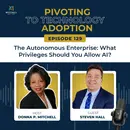
Steve Hall, Chief AI Officer at ISG, argues the question executives keep asking is the wrong one. Not what AI can do — what privileges you should allow it. He walks through the autonomous enterprise, what his market data shows about who is capturing AI's value, and the one word he says determines whether adoption happens at all.
TOPICS COVERED:
- Why 2025 changed the question from what AI can do to where you should let it act
- The autonomous enterprise — and what earning autonomy actually requires
- Measuring AI trust at the individual level, not the organizational one
- Token maxing and why board conversations moved from productivity to outcomes
- What the ISG Index shows about hyperscalers versus the firms doing the work
- The one-word answer to what improves workforce adoption
- Why the C-suite sets vision but work units decide the outcome
- The EU AI Act, guardrails, and the overregulation risk
(0:00) Welcome and Introduction
(2:23) November 2022 and the Cambrian Era
(4:46) Panic, FOMO, and Why You Are Not Behind
(5:56) The Autonomous Enterprise: What Privileges Should You Allow?
(7:40) Measuring AI Trust at the Individual Level
(9:07) What the Boardroom Mindset Has to Become
(10:48) Token Maxing and the Shift to Outcomes
(11:56) Work Gets Done at the Execution Level
(12:44) Learn, Unlearn, Relearn
(13:18) Inside the ISG Index
(15:45) What the AI Economic and Sentiment Indexes Revealed
(18:34) What Actually Improves Workforce Adoption
(19:34) The One-Word Answer: Trust
(20:23) AI-Centered, Not AI-First
(22:56) Who Owns Adoption in the C-Suite
(25:45) From the Boardroom to the Break Room
(27:58) Governance, the EU AI Act, and Overregulation
(30:44) Jobs Do Not Collapse. Roles Change.
(32:14) Where to Find Steve and the ISG Index
ABOUT THE GUEST:
Steven Hall is Chief AI Officer at ISG (Information Services Group), a globally recognised technology market authority who works with enterprise leaders to turn AI into measurable business value. With more than 20 years advising enterprise technology leaders and nearly a decade leading ISG's EMEA business, he helps organisations move beyond pilots and proofs of concept to adoption that changes how work gets done. Each quarter he is the voice of the ISG Index, the firm's long-running read on the health of the technology sector.
ABOUT DONNA P. MITCHELL:
Founder of The Transformation Authority and CEO of Mitchell Universal Network, LLC. Forbes Business Council Member. Senior Executive Healthcare Think Tank Member. 49 years of enterprise transformation across 5 regulated industries and 4 transformation types, enabling 150,000+ professionals.
GET THE BOOK:
Pivoting to Technology Adoption: Mind the Gap
amazon.com/dp/B0GP3CWH2H
CONNECT WITH STEVEN:
LinkedIn: linkedin.com/in/steven-hall-b427223
ISG: isg-one.com
CONNECT WITH DONNA:
LinkedIn: linkedin.com/in/donnapmitchell
YouTube: @TheTransformationAuthority
Website: pivotingportal.com
NEWSLETTER:
The Transformation Brief
transformationbrief.beehiiv.com/subscribe
SPEAKING & ADVISORY:
pivotingportal.com/speaker
New episodes every Tuesday.
Forbes Business Council Member
PIVOTING TO TECHNOLOGY ADOPTION
EP129: The Autonomous Enterprise: What Privileges Should You Allow AI?
Guest: Steve Hall, Chief AI Officer, ISG (Information Services Group)
Host: Donna P. Mitchell, The Transformation Authority™
Published: Tuesday, August 25, 2026
Donna P. Mitchell (0:00): Welcome to Pivoting to Technology Adoption. I'm your host, Donna P. Mitchell, The Transformation Authority™. Every week I sit down with executives, strategists, and innovators to tackle the one problem no one's solving: why 70% of technology transformations fail. Let's pivot. Good morning, good afternoon, and good evening. Welcome to Pivoting to Technology Adoption, and today I have Steve Hall. Now, Steve is Chief AI Officer at ISG Information Services Group and a globally recognized technology market authority.
Donna P. Mitchell (0:39): He works with enterprise leaders to turn AI into measurable business value, helping organizations move beyond pilots and proofs of concept to adoption that transforms how work gets done and how value is really created. With more than 20 years advising enterprise and technology leaders and nearly a decade leading ISG's EMEA, Europe, Middle East, and Africa. For those listening and wondering what that is, that business, Steve has helped executives navigate technological change from cloud and digital transformation to today's AI revolution.
Donna P. Mitchell (1:16): He is known for turning market complexity into clarity. His work connects AI strategy with execution, separating genuine opportunity from hype, assessing readiness for AI at scale, and facing the practical realities of data, governance, accountability, and ownership once AI moves into production. What really struck me about Steve's work is he put emphasis on the people problems and the issues that take place on that side. And that is the side that we all really need to be looking at.
Donna P. Mitchell (1:49): We can't just avoid it. And that it isn't the imagination, it is about readiness. Executives keep asking what AI can do. Steve says should be asking, where the organization is ready to let it act. So now I'd like to introduce Steve. Welcome to the show and say hello to your audience and ours and share a little bit more about what you're doing today and what's going on at ISG that you wanted to share, especially in that area.
Steve Hall (2:23): Great. Well, thank you, Donna, for the great introduction and for having me on your show. I'm really looking forward to it today. You know, I think November 2022 was an incredibly pivotal moment in our industry. And obviously that was the launch of generative AI, ChatGPT really hitting the world. When you've been in this field as long as I have, you've seen a lot of different trends. I was on the Webverse. I was on DAOs and decentralization and blockchain early in my career.
Steve Hall (2:55): I really started the launch of large e-commerce, worked for multiple companies that were doing that. And so it's easy sometimes to get caught into the hype. But I think in January of 2023, what people started recognizing is this wasn't hype. We had reached a stage where we almost had superintelligence and how we thought and how we started working with AI, with the technology first, was mind-boggling. And a bit like the iPhone, because everybody had it and it was on the consumer side and we had 100 million users within 100 days, everybody wanted to bring that to the enterprise and the enterprise was completely overwhelmed.
Steve Hall (3:36): So I remember standing on stage and it was a really big conference and I happened to be doing the keynote. And I said that we're entering the Cambrian era. And a lot of people looked at me, Steve, you've got hyperbole going on. I said, no, listen. I say the Cambrian era was really the spark for life on Earth. It was really where everything sort of evolved to the point where life just exploded on Earth as we saw through plants, animals, everything else. And with the Cambrian explosion and the explosion of new life and stuff came forward, there was inventions across the board, which is so similar to what we see in AI.
Steve Hall (4:13): So when you look at the markets, you saw capital moving into AI firms, you saw thousands and thousands of startups. You saw individuals being able to create new opportunities. Within 6 months, every enterprise that we work with, and ISG's privileged to serve over 900 clients a year, tend to serve the G2000 at the upper end of that space. We're privileged to sit and work with the most senior people in those organizations.
Steve Hall (4:43): And by June of 2023 and definitely into 2024, we saw this panic. We saw this FOMO, this fear I'm missing out, as the biggest trend ever. The hype scale was off the roof. And so we really started telling people, calm down. You're not behind. There's a lot of hype. There's a lot of things, and you need to be in the experimentation mode, and you need to have a vision of what this means for your organization. Let people grow. Let people expand. Apply learning and development in a way that you can still maintain the controls.
Steve Hall (5:15): Let's use this as a learning phase. By, I would say, 2025, organizations really started thinking, now what? How do I monetize this? And we moved from this, what can AI do? Sort of what are the use cases that I could think about? Into what I really said was, where should you use it? Not what can it do? Because we know the tech is far ahead. The regulators were very panicked at this time as well. And so there was not just the EU AI Act, but a lot of state, not enough federal, but a lot of state regulation on the use, protect people's jobs, other things coming out.
Steve Hall (5:52): But it became really central to say, essentially, if we're going to move into what we've kind of coined as the autonomous enterprise, what does that really mean? And it's not what AI can do, but what privileges should you allow it? And where is humanness or human intelligence important versus the things that AI can naturally do? The great opportunity right now that we see it is from the technology side, if you look at the models that have been released sort of since April, we now have models that are 2 trillion, 3 trillion plus parameters.
Steve Hall (6:28): Expert modes in these models that I think we're up to 62, 63, 64 experts, which means 64 different fields of knowledge with expert level, PhD level expertise. With models able to take 16, 20 experts from all of these different fields to apply it to your problem. When have we ever had that in, not only in technology, but in anything? You know, even the biggest corporations to say, I'm going to go out and hire the top 16 experts or the top experts in each of these fields to solve this problem, sort of unheard of.
Steve Hall (7:06): Now we all have it at our fingertips in an unbelievable way. So in many ways, superintelligence is here from the problems that it's able to solve. But now what do you want it? What permissions do we give it? What trust do we have? And how do we keep the humanness? And I would say really the intelligent enterprise, not the artificial intelligence, but the human intelligence and the intelligence enterprise really connected to drive that. So that shift was massive for us as we thought through that. It impacted how we thought about organizational design. It impacted how we thought about people. One of the first things that I did late last year was I acquired a technology company out of London called AI Maturity Index, which was 100% focused on understanding at the individual level how people were using AI.
Steve Hall (7:55): And the thing that I loved about it is it's a bit like using Myers-Briggs or DiSC or any of the other kind of personality tests. That really get to your trust level and how different cultures, different people have trust in technology. Some cultures, some places, if AI hallucinates, it's completely wrong. I have no trust in it because it made a mistake. But we take that same thing and we're perfectly fine with people making a mistake, learning, relearning, learning again as they go through that. But with AI, we had this unbelievable standard on perfection.
Steve Hall (8:27): And the models were brilliant, but it was these standards. So we got to the understanding of how people trust and how they think through that. And that was sort of the breakthrough moment to really kind of talk through what does that mean for organizations? What does that mean for the individual? Obviously, we had to tie that to organizational readiness. Do they have the capabilities? Do they have the trust built in? Can they do those things? But it wasn't so much focused anymore on data, technology, network, cloud, all the various things.
Steve Hall (9:01): It was about what do we need to do to get the people ready and what trust should we give in AI?
Donna P. Mitchell (9:07): So let me ask you this. In the boardroom, in C-suite, when you think about the organizations and the clients, what type of mindset do they need to have? And who should be included in that group, let's say, that makes the final decision? What I found in speaking with clients and leadership, there seems to be the need to get everyone moving forward from an old way of thinking into the recognition of what you just said. This is superintelligence, and the output and the impact is something that we've never seen before.
Donna P. Mitchell (9:44): For those listening, how do they make that happen? Every day, they seem like they're pushing the boulder up the hill. What do you recommend?
Steve Hall (9:52): So it's interesting the way that the boardroom perspective has shifted. Especially, I would say February of 2026 was another big pivotal moment. That was really the launch of Claude Work, where everybody all of a sudden saw with Claude what it could do with coding, what it could do with creative design, what it could do with documents, how it was so integrated in the core work that all of a sudden knowledge workers do. And I think up to that point, and even a little bit beyond that, most boards were focused on productivity improvements.
Steve Hall (10:25): We all understood that AI was going to be able to increase the margins, reduce the cost of delivery, have a positive impact on SG&A, all of those things. So the focus was really essentially on how do we do that? There was also a really big push on what are those new businesses that we should now get into and how do we drive those types of things? The other thing that happened in February though, if you recall, was we started coming up with words like token maxing.
Steve Hall (10:56): And we heard a lot of organizations spending all of their tokens that they had allocated in a year in one month. You know, we faced that ourselves. We had multiple situations where one individual expended 30 to 40% of the total token budgets that we had allocated. And so all of a sudden, things that you thought were fairly low in the organization sort of became board-level investment decisions and how do we manage that? I think today though, and it's so funny how fast these periods are moving. Today, most of the senior execs that we speak to really talk about how do I get the best outcomes and how do I drive that for my organization?
Steve Hall (11:34): And what does that mean? And quite frankly, it goes back to a lot of the core of our business. You know, you and I have both grown up through the '70s and '80s and '90s with technology and what's that means and that growth piece. And there's a lot of core principles that we learned there. You have to be able to look at business processes. You have to look at value streams and workflows. And it's great to have a vision, but work doesn't get done at the vision level. Work gets done at the execution level.
Steve Hall (12:04): So how do you really pull those things together and say, we're going to reimagine work. We're going to reimagine how we do this. But we're going to do this at the business processes where it makes sense. So how do we deconstruct how we do things and reconstruct with, I'll say, AI or the large models embedded, but with people? And the skillset, which was the core of your question, became change leaders. I would say is probably the best word for it. People that are able to articulate the vision. This is where we're going.
Steve Hall (12:37): This is why. This is how it's going to be beneficial to you. This is the journey that we're going to be on. And you said something earlier that I love. More of us, all of us need to be continuous learners. I think the number one skill today over everything is the ability to learn, unlearn, and relearn, and be completely open-minded to do that. Because what we know today and what I know on, in August of 2026, I'm going to have a lot of new information in January 2027, and I just can't hold on to all of my old thoughts, ideals, et cetera, if I'm not able to look at things and relearn those.
Steve Hall (13:15): So those are sort of the skill sets of the future.
Donna P. Mitchell (13:18): So let me ask you this. When you talk about the skill sets, ISG Index, you have a lot of data. You have a lot of information. I want to hear, and I'm sure my audience wants to hear, tell us about the information that you have and what you learn from all that data. What exactly, what type of information do you have that you can share?
Steve Hall (13:38): That is absolutely a brilliant question. So one of the things that I do is every quarter, I get to be the voice, but we've got an amazing team that goes through and looks at the health of the technology sector. So we look at the spend, the number of signed contracts, what we call annual contract value or ACV, and total contract or TCV. Of really the entire tech sector. So we look at all the hyperscalers, which means the Googles, the Amazons, the Microsofts.
Steve Hall (14:11): We look at all their spend and how their growth has been impacted. We look at all of the managed services providers. So the IBMs, the DXCs, the TCSs, Hexaware, HCL, Wipro, over 250 companies that we look at there. And then we look at all the SaaS providers. So the Workdays, the Salesforce, the SAPs, 2,500 providers that we look there. And we look at the entire ecosystem and we say where tech is going, where tech spend is going, and how enterprises are making decisions.
Steve Hall (14:45): It's an amazing effort. We have been doing this for 20-plus years. In October, it'll be our 96th consecutive quarterly index call. Thank you. It's, we've got Wall Street analysts, we've got enterprises, we got service providers, we've got software providers. We typically have 1,500+ people that engage in this audience on a quarterly basis, just to understand how we think the market is going to move. The great thing about it is though, because of all the deal flows that we do, so ISG advises over $20 billion of tech spend per year, primarily on big managed services outsourcing contracts.
Steve Hall (15:21): And we influence over $200 billion of tech spend per year. So we've got a massive insight on the tech spend for a company that a lot of us have never heard of, quite frankly. That's the beauty of B2B sometimes on services firms. With that influence though, we really help organizations make key operating decisions on how to do that. Now this quarter, which was why everybody's interested in it, we came out with what we call the AI Index. We did 2 things. We came out with the AI Economic Index and the AI Sentiment Index.
Steve Hall (15:56): Both of them were important because what we wanted to look at is we've got all of this hype, but how is this hype related to adoption? How is it related to really where the market is moving? How do the stocks relate to it? So we really came up with an overall index that said, here's the impact of AI on these specific sectors. So let's take the hyperscalers, for example. We looked at hyperscalers making massive investments in capital. We looked at their revenue growth, we looked at their profitability, and we looked at their market share.
Steve Hall (16:29): But we also said, you know, the hyperscalers had been growing 40 to 50%. Unbelievable growth. No one's seen that since we've been tracking this at that level sustained. But 70% of that growth is coming from very few. It's coming from the frontier model providers, the Anthropics, the OpenAIs, et cetera. And you've got this kind of ecosystem building that's investing in itself, building capacity, using that capacity, blowing out the huge data centers, all quarters sort of funding that, right?
Steve Hall (17:03): But then we looked also at what we call the AI sentiment. What's the sentiment of buyers and sellers on really how AI is being impacted? We looked at that and managed services, it'll give you a good thing. Managed services only grew about 7% since what we call the inception date. That was essentially, we used December 2022 because that was really the launch of modern AI, if you will. Their stock was down almost 50% as an industry over that period. So incredible belief on the front end with hyperscalers that you can almost call the picks and shovels.
Steve Hall (17:36): Great stock prices, great growth, incredible energy, incredible hype. The managed services who were actually the executioners, the ones that were actually executing the work and doing the work, limited growth, profitability negatively impacted, profit and revenue per employee down, stocks down about 55%. The amazing thing though is the enthusiasm on the managed services side was just as high as the enthusiasm on the hyperscaler side.
Steve Hall (18:08): So the thought was really, you know what, we're just in the early phases of this. We have all this hype. People feel like they're so far behind, but we haven't even moved into execution. And all the real work and all the change that we have to do as a society and as enterprises and as individuals, we're just getting started. So there's still this huge enthusiasm and this huge amount of work. That was sort of the big insights that we got from this.
Donna P. Mitchell (18:34): So thank you for that. So when you look across the industries, regulated, unregulated, the different industry sectors, there must be a trend that you see that you're mentioning in regards to the adoption. But what is it that you feel would really improve the adoption of the workforce and enablement going forward that, that we're missing right now? Do you see any trends from a, from a global standpoint? Do you see more success depending on the culture or a society in that specific area?
Donna P. Mitchell (19:08): What are you seeing as the key elements for success, let's say, for adoption with the workforce?
Steve Hall (19:16): You know, it's interesting because more than anything, I think this conversation starts at the dinner table, quite frankly, and not the boardroom. And maybe it starts at the water cooler as well in organizations, or as you love to say, from boardroom to break room. I think the conversations are happening at the dinner table and the break room piece. The challenge that I see right now, I would put it in one word, and that is trust. And trust of that management is going to make the right decisions. Trust that there's a future for our children and our grandchildren and everything else with this intelligence.
Steve Hall (19:50): Trust that tech leaders and governments are going to make the right decisions with regards to the guardrails and the controls that are required here, and trust in the belief that they're still gonna, we're going to still have a role in society and in our workplace as we go forward. And so trust is built on a lot of foundations. And I think when I think about trust, it starts with, again, almost change leadership and being really clear about what that means to an organization.
Steve Hall (20:23): Give you a personal story. We're working on our 2027 through 2030 AI strategy right now. And with that strategy, we have our tagline and everything else within the firm and external is AI-centered firm, right? We're technology, you know, we're an AI-centered technology research and advisory firm. We're not AI-first, not everything should be AI, but we're very AI-centered. As I was leading this strategy, and I've just kicked it off over the last 2 weeks, and I've pulled a set of incredibly intelligent people across the globe, the first question that came to me from the team was, what does it mean to be AI-centered from an employee standpoint, from a colleague standpoint?
Steve Hall (21:08): How does that change how I work? How does that change my use of technology? How does that change my trust? What are the things that I can and can't do? And as I really listened to the question, it all came down to what's the future of how I'm going to integrate and work with this technology and the new things and the trust that we build it. So I think change leaders and boards really have to articulate that vision and be able to be really clear on how that drives. Now, on the other side of that, we're also pushing what we really show as kind of what we're again calling the autonomous enterprise.
Steve Hall (21:41): That if organizations are going to adapt and agents are going to be 24-hour workers and agents are going to be integrated with, you know, with our colleagues to do work, and we're already seeing that, how do you empower that across where you get the best of agents and the best of humans? And how do you make sure that you understand what agents are doing, agents understand what we are doing, and we're doing that in a very collaborative manner. And the things that we're great at, creativity, thinking through complex situations, empathy, bundled with the amazing ability to apply expert knowledge to very finite problems, to be able to summarize massive amounts of data and docs in clean ways, in ways that we can now consume, right?
Steve Hall (22:27): There's no way I could consume 64 different experts' PhDs in a way that would be meaningful for my client, but I could get an agent to do that. Put it in a way that I can consume and help our clients understand that. So that level of trust and deeper understanding, I think, is the key change.
Donna P. Mitchell (22:41): I wonder sometimes if that is something that needs to be ongoing, the level of trust, because it's not something that's going to happen overnight. And I think leaders need to be aware of that. When you look at the process, where do you think the C-suite should have the ownership of the success of the adoption? Who should have the success of the adoption? Adoption to make sure it happens? Not that we implement the technology and we're good to go.
Donna P. Mitchell (23:13): Because that's not what happens.
Steve Hall (23:17): You've got it right. That is not what happens at all. I think the C-suite has to set the vision and the investments. But what we've seen with clients is every one of those work units have to be 100% bought in on what they're doing. So if I'm working at an organization, I won't mention any specific organization, but if I'm working at a really large organization, it's easy for the C-suite to say, we're going to be AI first. We're going to embed AI in all of our products. We're going to integrate this and we're going to go to the market and we're going to tell the market that we're going to take, you know, reduce our SG&A or reduce our cost base by 30%.
Steve Hall (23:53): And that's a great messaging for the C-suite to do. And that likely carries down through the organization. The challenge is when you go into large organizations, you got product, you got product design, you got finance, you have HR, you have IT, you have procurement, you have all of the business leaders on whether it's insurance or manufacturing, whether it's building cars. So you have all of these organizations that literally have thousands of processes that need to be aligned with that vision.
Steve Hall (24:26): So you have to bring it down to where that vision is set, the investments are made, the goals are clear, and you really empower business units to drive that vision forward. I mean, if you can't compare this to, let's say, a large ERP implementation or a large SAP implementation where centralized control is almost needed to be able to do it, and you get feedback from all the business units on how you're going to change because you want a greenfield implementation or you want a standard. This is thousands of agents now that need to be managed in a central way for security control, SOX, everything else.
Steve Hall (25:03): But manage in such a way that you're unleashing the new power and the new capabilities. And that really has to be at the business level where you can get it. The one advice I would say to lots of clients is make sure though that vision is clear. You've got an analytics strategy, you've got a really great data strategy, and you understand how you're using your data and your insights. Because if we all go down this path and we all put in the same LLM, we all do the same things, we all sort of start looking like each other and we miss the differentiations that make us so unique.
Steve Hall (25:37): We make those, we miss the things that we all bring as individuals. And so we do need to make sure that we hold onto those things and that will help drive a lot of our strategy.
Donna P. Mitchell (25:49): So let me add a couple of other little, little pieces in my work. You are absolutely right. The mission, the vision, the business units, but just to take it a step further with the personal individuals that are there, you'd be surprised on how the mission, vision, and the meaning is not in line with the message, even though it has been consistently worked on and presented. And so much in today's world, people rely on who they trust, like you said before. And if the champions and the network isn't there with the trust, all the work that's done in the boardroom is not going to make it to the break room if the head of the business unit got an attitude and really don't believe in the mission and the vision, and the rest of the people can feel it.
Donna P. Mitchell (26:37): And they really know at the end of the day, well, it didn't work last time. He don't think it's going to work this time. So why should I? You know, them attitudes that really take place. And I think it's important that people recognize the impact of what's happening around them, in their network, in the silent networks, and those visuals, it's like walking into a medical office. You know how that provider operates his business, his care with his patients, soon as you walk in the front office and the behavior and the attitudes.
Donna P. Mitchell (27:12): And I think it's a wonderful thing with the indexing and all the information that you have. And the insight that ISG can provide where your clients are in great hands with you and your team, because at the end of the day, you pretty much can see it all. But I think the additional piece that all of us need to see, whether we're on the change side, the project side, the business unit side, who you are at home is one thing. Who you are when you come to work is another.
Donna P. Mitchell (27:43): And all of us are leaders. All of us are change agents in today's AI era. I think that's the most important thing that those that are listening need to recognize. Everyone's behavior and input and contribution is really important. With that said, the governance that's taking place overseas more than here in the United States and other areas of the world, are there any concerns that you may have that you would want to share or are there any highlights that you want to be able to make sure people take away?
Steve Hall (28:17): Yeah, it's interesting. We've launched 4 sort of key initiatives within ISG. We have AI at Scale, which is really helping drive broader adoption across organizations. Our number 2, though, is exactly what you said. It's called AI Workforce Transformation because we think it's the biggest opportunity and impact that transformation programs is understanding where your colleagues are, your peers are, and somewhat meeting them where they are and helping them transition to the new piece.
Steve Hall (28:48): Then we have AI Economics, which is masses, which we've talked a little bit. But the 4th piece that we have is AI Governance. So I love this conversation because we've kind of bookended exactly how we think about the market right now. The EU AI Act is... I was over, I was in Europe the whole time as it started off. I spent the last almost 8 and a half years living in Europe, living out just outside London. And there's some things in there that are exceptionally good. And I think ethics and the things that you can and can't do with AI are critical.
Steve Hall (29:20): And the tiering that we did with high, medium, and low, and really putting in specific use cases on the legal use of AI, let me just be really clear on this, was exceptional work. And I think we need similar frameworks to do it. The concern that I have is we always have a tendency to overregulate when we don't understand something. And as AI evolves, we have to be careful that we have the right guardrails, which I think the EU AI Act has done a great job establishing, but not overregulate where we impact the flow of capital to drive really the investments that need to be made to take this to the next level as we go forward.
Steve Hall (30:04): I'm a huge reader and, and huge, huge reader. One of the books that I just read was If Anyone Builds It, We All Die. Now it sounds extreme. And I wasn't necessarily in agreement with everything, but I love to read conflicting views sometimes just to have a more worldview. And this goes through so many different scenarios on how AI can go rogue. And we've already seen it with a lot of the breakouts and the security breaches that we've seen. So we absolutely need these guardrails and we absolutely need controls.
Steve Hall (30:37): We also have to understand that people are valued in many ways by the work that we provide and the value that we provide back to society and through our enterprises. So I'm not a big fan of any of the universal basic income or any of the things that the regulators are considering as if jobs are going to collapse. We are incredibly creative as a society and jobs are not going to collapse. Roles are going to change. People are going to change. We're going to learn to work with tech in new ways. But we've been doing that for years and years and years. And all of these prognoses have never heard walked through.
Steve Hall (31:11): You know, I read a book in 2010 that called, or 2011 called Lights in the Tunnel. It was the demise of all of us society because of automation. It wasn't AI then. It was, you know, kind of automating. It never happens. Jobs rise and new things are created. But I do think the regulators have to stay on top of it. The other thing that I'm concerned about right now is in some cases, the regulators are well ahead of where the technology is, saying that we need to have all these insights and everything on exactly what the models are doing. And I understand why.
Steve Hall (31:41): And you're seeing these things like observability, but we haven't even got to the point where we really understand how all the decisions are made in a repetitive way, right? It's not a deterministic system. It's a probabilistic system. No, it isn't. It's funny sometimes to watch where the regulators go. And where they don't go, where they probably should be thinking about things, but it's going to accelerate. You know, they'll always probably be a year to 18 months behind the tech a little bit, which is probably okay right now as we continue to, you know, that we still need the capital to invest to drive the insights that we need.
Donna P. Mitchell (32:14): So how can you be reached? How can people reach out to ISG Index?
Steve Hall (32:18): So people can reach out to ISG in general just by going to www [isg-one.com]. The ISG Index, you can personally reach out. We can send you an invite. You can go to our website and get an invite to do it. It's a great quarterly call if you really want to get a sense of what's happening in technology.
Donna P. Mitchell (32:42): Sounds exciting. So Steve, I am so glad to have you on Pivoting to Technology Adoption. Is there anything that we really needed to share that we didn't touch on that you want to mention?
Steve Hall (32:53): The only thing I need to share that we didn't touch on, Donna, is a huge thank you. It has been such a pleasure meeting you and talking to you, and we are going to have to do this again. So just a sincere thank you to you.
Donna P. Mitchell (33:04): Well, thank you for being here, and it's a great conversation. I'm glad you want to come back because I want to have you. The team is going to want to have this conversation and extend it on. So with everyone listening, thank you for listening to Pivoting to Technology Adoption. And we're shaping tomorrow together. Thank you. Thank you for listening to Pivoting to Technology Adoption. If this episode gave you something to think about, subscribe, leave a review, and share it with a colleague who needs to hear it.
Donna P. Mitchell (33:34): My new book, Pivoting to Technology Adoption: Mind the Gap, is available now on Amazon. Visit pivotingportal.com to work with me directly. I'm Donna P. Mitchell, The Transformation Authority™. Until next time, mind the gap.
ENDNOTES AND SOURCES
Steve Hall referenced a book he read as "If Anyone Builds It, We All Die." The published title is "If Anyone Builds It, Everyone Dies" by Eliezer Yudkowsky and Nate Soares. The transcript reflects what was said on air.
Steve Hall referenced a 2010 or 2011 book as "Lights in the Tunnel." The published title is "The Lights in the Tunnel: Automation, Accelerating Technology and the Economy of the Future" by Martin Ford, published 2009.
The 70% figure in the introduction is the show's standing thesis statement by the host.
All market figures, client counts, contract values, growth rates and index data cited in this episode are Steve Hall's statements on behalf of ISG and were not independently verified by Mitchell Universal Network, LLC. Guest views are his own.
GUEST
Steve Hall
Chief AI Officer, ISG (Information Services Group)
Website: isg-one.com
LinkedIn: linkedin.com/in/steven-hall-b427223

Chief AI Officer
Steve Hall is Chief AI Officer at ISG (Information Services Group) and a globally recognized technology market authority. He works with enterprise leaders to turn AI into measurable business value, helping organisations move beyond pilots and proofs of concept to adoption that transforms how work gets done and how value is created.
With more than 20 years advising enterprise technology leaders and nearly a decade leading ISG's EMEA business, Steve has helped executives navigate successive waves of technological change, from cloud and digital transformation to today's AI revolution. Known for turning market complexity into clarity, he helps executive audiences understand what matters, what comes next, and how to make confident decisions about emerging technologies.
Steve’s work focuses on connecting AI strategy with execution. He helps organisations separate genuine opportunity from hype, assess their readiness for AI at scale, understand where AI genuinely fits, and address the practical realities around data, governance, accountability and ownership once AI moves into production.
Steve combines market insight with practical client experience, giving audiences clear, actionable guidance they can apply in their own organisations.