AI Adoption Without Accountability: Who Owns the Decision with Daniel C. Rodgers
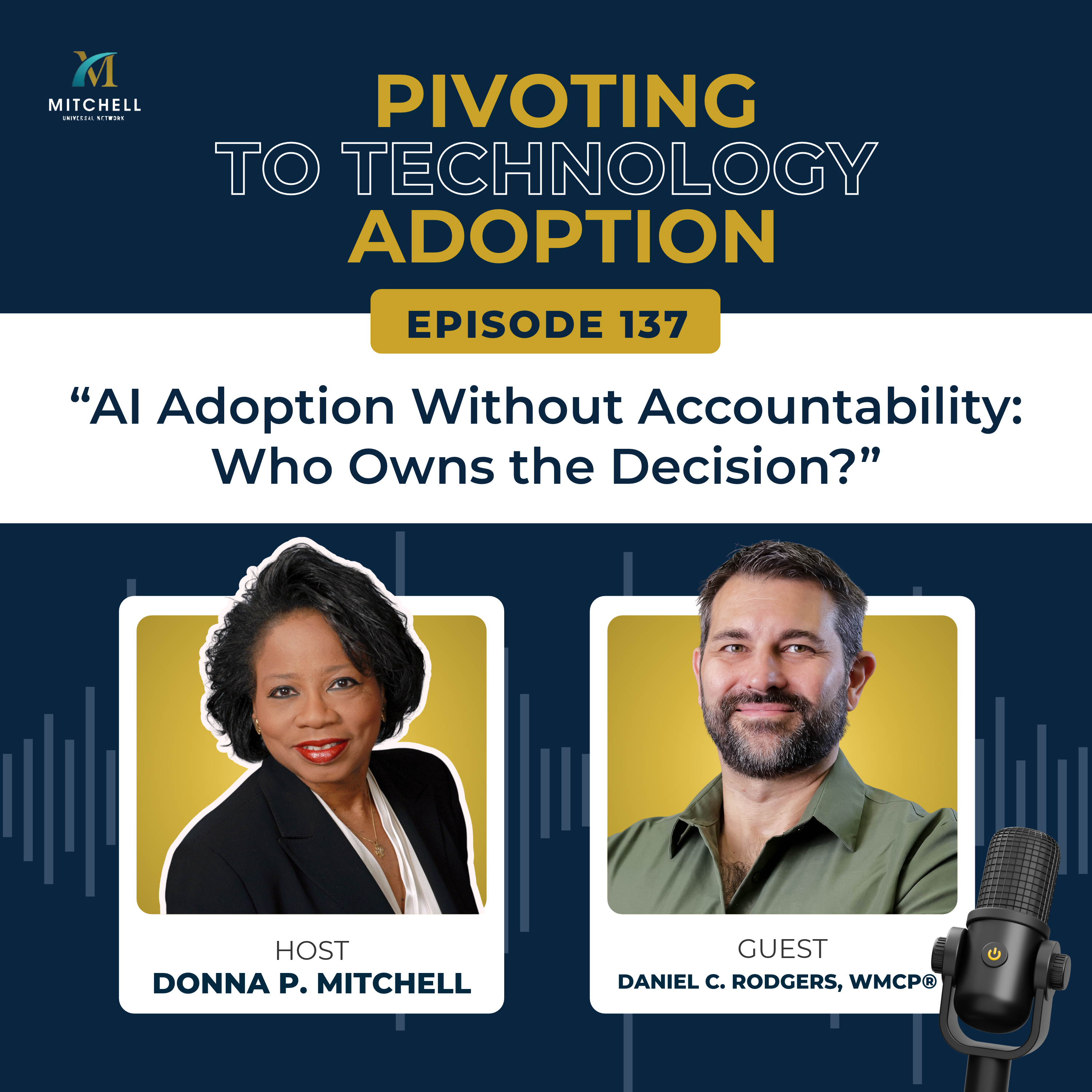
Why everyone wants control but not accountability, why experts are not immune to automation bias, and why every AI workflow needs a person who owns it.

 Apple Podcasts

 Spotify

 Castro

 RSS Feed
What happens when AI starts to work so well that people stop questioning it? Daniel C. Rodgers, WMCP®, a former Microsoft and Google technology leader and author of the award-winning novel Killswitch, has seen technology adoption from the inside. He explains why teams can get fast at building reports but not decisions, why experts are not immune to automation bias, and why people want control but not accountability. He shares his JUDGE framework for using AI deliberately, and what leaders can do to build a culture where people use AI openly and well.
TOPICS COVERED
- Why teams get fast at building reports but not decisions
- Automation bias: when people trust the tool more than themselves
- Why experts are not immune, and what the research shows
- How skills fade when the tool does the work
- The JUDGE framework: justify, undo, designate, guard, exercise
- Why every AI workflow needs an accountable person
- What patients can ask their doctors about AI
- Why your data can't be pulled back out of an AI system
- How leaders build a culture where people use AI openly
(00:00) Welcome and Introduction
(00:24) Meet Daniel C. Rodgers
(01:27) Building a Plan, From Ohio to Big Tech
(06:08) Where AI Decisions Go Wrong
(06:32) Fast at Building Reports, Not Decisions
(09:15) When AI Became Real
(10:38) Why AI Feels Out of Control
(12:09) Automation Bias
(13:21) The Rubber Stamp Problem
(14:03) Every AI Workflow Needs an Owner
(14:33) What Concerns Him Most
(15:38) Control but Not Accountability
(16:03) Experts Aren't Immune
(17:00) When Skills Fade
(18:02) The JUDGE Framework
(19:46) The Best Guardrail for the Patient
(20:56) Most People Hide Their AI Use
(21:52) Strategic Thinking Is the Leader's Value
(22:52) Approval Isn't Ownership
(24:06) Personal AI Agents and Your Data
(25:16) Why Your Data Can't Be Deleted
(28:26) Killswitch: Why Fiction
(34:10) Why Would People Give Away Humanity?
(35:59) Before You Add New Technology
(36:44) Build a Culture Where People Use AI Openly
(39:36) Where to Find Daniel
FROM THE EPISODE
"People would like control, but not accountability. And that's just not the way it works." Daniel C. Rodgers
ABOUT THE GUEST
Daniel C. Rodgers, WMCP®, spent twenty years in technology at Microsoft and Google. At Microsoft he was a Product Management Lead for Xbox Live. At Google he was a Senior Manager in Google Cloud's technical program management group, where he led programs delivering AI infrastructure and generative AI services, and served in the technical governance group. He retired at 42 and turned to writing, teaching, and publishing. His first book, Escape The Clock, is an award-winning bestseller on financial independence. His debut novel, Killswitch, won Literary Titan's Gold Book Award for Best Science Fiction. It follows a world that adopted AI so completely it handed over its judgment. He hosts the Escape The Clock podcast and lives outside Seattle.
CONNECT WITH DANIEL C. RODGERS
Website: escapetheclock.com
Books: Killswitch and Escape The Clock
SOURCES
Radiologists' accuracy fell from 82% to 45.5% when the AI suggestion was wrong (very experienced readers): Dratsch T, et al., "Automation Bias in Mammography," Radiology (RSNA), May 2023
Adenoma detection in non-AI colonoscopies fell from 28.4% to 22.4% after regular AI use: Budzyń K, et al., The Lancet Gastroenterology & Hepatology, August 2025
57% of employees say they hide their use of AI at work: University of Melbourne and KPMG, Trust, attitudes and use of Artificial Intelligence: A global study 2025
The 4 to 5x yearly figure measures the training compute of frontier AI models, not capabilities: Epoch AI, "Training compute of frontier AI models grows by 4-5x per year," May 2024
Six frontier AI developers use chat data for training by default; not all offer an opt-out: King J, et al., Stanford, User Privacy and Large Language Models, October 2025
The AI Kill Switch Act was introduced in the U.S. House on July 23, 2026: Nextgov, July 2026
Guest views are his own.
ABOUT DONNA P. MITCHELL
Donna P. Mitchell is the founder of The Transformation Authority™ and CEO of Mitchell Universal Network, LLC. Forbes Business Council Member. Senior Executive Healthcare Think Tank Member. Author, Pivoting to Technology Adoption: Mind the Gap. Enterprise transformation across five regulated industries and four transformation types, enabling 150,000+ professionals.
GET THE BOOK
Pivoting to Technology Adoption: Mind the Gap
pivotingtotechnologyadoption.com
CONNECT WITH DONNA
LinkedIn: linkedin.com/in/donnapmitchell
YouTube: @TheTransformationAuthority
Website: pivotingportal.com
Company: mitchelluniversalnetwork.com
NEWSLETTER
The Transformation Brief™
transformationbrief.beehiiv.com/subscribe
SPEAKING & ADVISORY
pivotingportal.com/speaker
LISTEN ANYWHERE YOU GET YOUR PODCASTS
Apple Podcasts, Spotify, Amazon Music, iHeartRadio, and every major podcast app
All episodes: pivotingtotechnologyadoptionpodcast.com
New episodes every Tuesday.
Forbes Business Council Member
PIVOTING TO TECHNOLOGY ADOPTION
EP137: AI Adoption Without Accountability: Who Owns the Decision?
Guest: Daniel C. Rodgers, WMCP®, Author, Killswitch
Host: Donna P. Mitchell, The Transformation Authority™
Published: Tuesday, November 24, 2026
FULL EPISODE TRANSCRIPT
Donna P. Mitchell (0:01): Welcome to Pivoting to Technology Adoption. I'm your host, Donna P. Mitchell, The Transformation Authority™. Every week I sit down with executives, strategists, and innovators to tackle the one problem no one's solving: why 70% of technology transformations fail. Let's pivot. Good morning, good afternoon, and good evening, and welcome to Pivoting to Technology Adoption. This is Donna Mitchell, and today we [have] Daniel C.
Donna P. Mitchell (0:32): Rodgers, WMCP. And I have him today because he had an outstanding background. He's worked in technology in so many different positions that I don't even want to start naming too many of them. But he's worked in Microsoft, Google, and he's been a product manager, worked with Xbox. And there's just so many positions he's had, even with the governance side, AI. And he retired at 42. So I'm going to leave it there. And why don't you give us some more insight, say hello to your audience and ours, and give us a brief introduction on your past and why you're here, because you've seen it all from 360 degrees, I think.
Donna P. Mitchell (1:13): And I think you're the person that for those that are listening, to give them the insight that they need on the adoption gap and the different gaps that they need to be prepared for as they build their businesses or work in the corporations.
Daniel C. Rodgers (1:27): Hi, thanks for having me, Donna. I'm really happy to be here. Yeah, I would say my quick introduction for me is, you know, I really did what so many people did. I put myself the best I could through college. My parents helped a little bit as much as they could, but there was really no plan for that. We were trying to make ends meet in Ohio. I borrowed everything I could. I did a computer science degree, not really because I wanted to, but because I did a web search and it said it was the best salary I could get. Back in the day. And so I realized I would have to make money to pay debt.
Daniel C. Rodgers (2:00): And when I was all done and started getting that W-2 income, I just felt like I wasn't really getting ahead. I had over $100,000 in school loans, $20,000 in credit card debt. We had just signed a mortgage. We were having our first kid, just, you know, in Ohio, and wages aren't super high there. And I got organized and saw it was actually worse than I thought. And through that, I started to educate myself.
Daniel C. Rodgers (2:30): I was actually really fairly ignorant when it came to financial things. I really didn't know what a 401 was when I was asked, should I put money into that? I definitely did not know what a good interest rate was and how you should be using credit cards and things like that. And so I made a lot of mistakes. But got myself organized. And what happened was that organization developed into a plan, uh, really a program. And I made some moves. It helped me make decisions about when I should switch roles, when I should switch companies.
Daniel C. Rodgers (3:04): And, uh, I, it really led me through this interesting journey where I started at very small tech companies working on things like heating and air conditioning stuff. I was doing like everything from web design to onsite installations, uh, to more medium-sized companies doing like flight information display software for airports, you know, the arrival and departure screens, the paging systems. And eventually I made a bigger move, applied at Microsoft, and it was because I had hit my kind of pay ceiling in Ohio. I wasn't really able to make more as a lead than I was, even though I was fairly young.
Daniel C. Rodgers (3:38): And so I moved my wife and young child to Washington State, which is much higher cost of living, but gave me more room to grow my income. And what I didn't realize at the time is a company like Microsoft is like this megalithic company of companies, gives you more lateral opportunities than you would at another job. So I was able, instead of switching companies every 2 to 3 years, I was switching different groups and eventually I was switching roles.
Daniel C. Rodgers (4:09): So I started as a software developer. Eventually I moved to product manager. I was a product management lead for a while. And then Google came calling. Actually, it was 2 companies, Google and Epic Games. Both had, uh, I was considered, I had offers from both, trying to decide which one to go to. And one was a studio lead, one was a program management lead. And I really was really excited about the program management lead because I'd been doing program management, not just at Microsoft unofficially.
Daniel C. Rodgers (4:39): But in my own personal finance for an early retirement. I wanted financial freedom. I didn't want to work into my 60s. So I moved to Google. I worked at Google for 4 years. I was able to make some moves within there. I worked on everything from SaaS applications to cloud infrastructure, to reliability, to AI. And I ended up hitting financial independence at 42. I stayed at work a little longer, left at 43, and I've been, I guess, a quote unquote early retiree ever since.
Daniel C. Rodgers (5:11): I now podcast. I wrote an award-winning personal finance book, talks about how I did what I did so people can build their own plan. And I teach with nonprofits. And I finally wrote my debut science fiction book, which took me 2 years to write, but it's based on all of my experience working in artificial intelligence and talking about the realistic version of artificial intelligence that's coming, which isn't that the robots are out to get us, but it's when the technology works too well and the cost that we reasonably trade to being in a world where we've delegated our own human judgment and autonomy and that giving us maybe an option to turn that off and what that might look like.
Daniel C. Rodgers (5:54): So that's kind of it in a nutshell, but it's really been about just making moves throughout my life, making a lot of mistakes, and ultimately now reclaiming my time so I can live my best life.
Donna P. Mitchell (6:01): Well, you're doing really well with your life right now because I've got a lot of questions and we can't do it all today. But you happened to mention where I'm sure everyone else is interested in knowing first. Where do you see the detrimental decisions being made in the outcomes of AI today? And what do you think we need to be doing to avoid the pitfalls of tomorrow?
Daniel C. Rodgers (6:32): Yeah, AI has changed so much in my career. I mean, even back when I was in college, it was this very I took a graduate level class and it was also theoretical, very math oriented. I never thought I'd see it in my lifetime. When I was at Microsoft, I was working in Xbox Live as a product manager, and this was around 2017. And we actually started using AI at that time. And these were large language learning models and we were using them. We were collecting gaming telemetry. So we actually were studying gaming behaviors, like the social aspects, like, you know, multiplayer stuff like who plays with who, how long they play, what game they might play next.
Daniel C. Rodgers (7:11): And the idea was that we would experiment and try... we had this mandate to grow to 50 million active users. So, you know, get the ecosystem larger, have engaged users every month. And to do that, the idea was, is we would run some like A/B tests and experiments, and AI was a key piece of this. So we were taking all of the telemetry, we were taking these large language learning models, and we were creating these dashboards. And these dashboards were pretty powerful for a product manager like me because I do usability studies and then I would have actual user telemetry.
Daniel C. Rodgers (7:43): So you'd have what people would tell you, but then what people would do. And from these really nice reports, I could pitch different experiments to leadership about what we might do. But the idea was to really put these things out there, fail fast if possible, see what we can learn, but really start to grow adoption. But what I noticed was at a company like Microsoft is that there was a lot of hedging on these things. Like we'd have these leadership reviews where I was a, you know, I was a product senior product manager at the time, come in, present, even though it was AI and people were already getting excited about it.
Daniel C. Rodgers (8:22): There was always this sense that I don't know if I would do it that way, or maybe we should get some more data. And so we wouldn't really do many experiments. We would always end up having another meeting and building another report. And looking back, I call it deep pockets that drove a lot of that decision paralysis because, you know, when failure doesn't really hurt, nobody is really forced to make a decision. And it's kind of like this dashboard trap.
Daniel C. Rodgers (8:53): You can create these beautiful AI-driven dashboards, which creates these, like, the motion of progress. But no one's actually taking a bet on anything, even experiment, which is a fairly safe bet because you sample a small group and ramp it over time. So it was quite interesting. We got really fast at building reports, but not decisions. And by the time I got to Google, AI was really starting to become real. Like DeepMind was acquired. I was seeing from the inside how AI was happening in my lifetime, and it wasn't AI like I had experienced at Xbox, which was based on this idea of a large language learning model that could drive a really nice report.
Daniel C. Rodgers (9:35): It was because of this idea called the transformer architecture, which changed the game between GPU and TPUs being able to do parallel processing and hardware accelerated, because compute is very hungry when it comes to AI. You need to be able to process many, many, many different things at the exact same time to figure out the next word that you want to predict. But the idea of prediction got really smart. It went from this really dumb autocomplete that would forget what the 3 sentences prior to it, to being able to have all the context that you ever gave it.
Daniel C. Rodgers (10:09): And it would know if the word bridge was a land bridge, uh, a natural bridge, uh, a manmade bridge, the game Bridge, like it would know because it would have context. And so I started to see the development of that and I started to work on AI as well, like just from the infrastructure side, but also as a program manager, we could run real programs with it. And I can get into some of the failures there, but to answer your question, what I'm seeing now is this exponential scaling of AI.
Daniel C. Rodgers (10:42): There's been a 4 to 5x increase in capabilities in AI every year. Not 4 to 5%, but 4 to 5x. That is a huge hockey stick curve. And it's really scaring leaders in the technology space to a certain degree, because as a program manager, I would go in and present in a Monday's meeting to leadership, to, to like my peers. And I'd say, this is the risk register. This is the blast radius. This is where things could go wrong.
Daniel C. Rodgers (11:14): We think we can handle it or not. And usually by launch, it's mostly the same. Things really don't change all that much. You might have some tiny variations. With AI, the next day it can be completely different. So it can really feel like it's out of control. And I think for people who are trying to integrate it into businesses, when people are trying to integrate it into their personal lives, it's this both extremely exciting and tempting thing that can suddenly make you feel like you're getting your time back because you're delegating things that you don't want to do.
Daniel C. Rodgers (11:47): You're able to fill the gap of things that you never learned how to do. And you can start chasing adoption opportunities by building a new product, a website, a thing, something that would have been costly or need a team of people before now is suddenly feasible. So it's quite exciting. But the risk and the mistakes I see is that when it starts to work, people trust it. And the more you trust it, a few things happen.
Daniel C. Rodgers (12:17): It's called automation bias. The first thing is you start to distrust yourself, your own expertise more and more. So when AI is wrong, it's usually confidently wrong. And a very experienced person is more likely to know that it's wrong and be able to catch it. That's why we're seeing a seniorization of the labor force right now. Where more senior people are staying on and they're being kind of leveraged into monitoring AI and trying to keep it on the rails.
Daniel C. Rodgers (12:47): And more entry-level folks are not, that headcount is being suspended and the budget's being moved to data centers. We're seeing that in a lot of tech companies right now. Less hiring of entry-level and more retaining of seniors, but those seniors have to be replaced eventually. But the point is, is even those seniors have this bias where the more AI starts to work well, the more they trust it over themselves. And when it gets it wrong, they will also be wrong. And sometimes they won't even know it. And on top of that, when it's working all the time, you start to rubber stamp it and you start to go, okay, well, great.
Daniel C. Rodgers (13:29): Let me, as people, we're very, uh, we have a tendency to look for problems. Yeah. So when something's working, you stop paying attention to it. You go look for the thing that you have to go put your attention on. Well, if you rubber stamp the thing that the AI has been working, it's not deterministic. So it might, it might do the same thing 5 times, but the 6th time it might do something completely different. It's not like an algorithm, a heuristic that's completely going to do the same thing every time. And because of that, you can, if you turn your back on it and you're just kind of saying, yeah, it's working, it's working, but you're not really watching it, now you're going to get in trouble.
Daniel C. Rodgers (14:00): And these kinds of things can be avoided. But they do require a person to be accountable to every single AI workflow. And that is sometimes not what people want to do. They don't want to think that, okay, well, the whole point is I'm automating something away, taking something off my plate. But with AI, it's very risky to do that. So you always need to have someone accountable. So that's, to answer your question, that's one of the bigger issues I'm seeing right now.
Donna P. Mitchell (14:33): What really scares you, like personally, that outta everything that you've seen and the apprehension that's now taking place with leadership, let's say, what is the biggest thing that concerns you with the trends and creativity and the development and the advancements as fast as it's going? 'Cause it's like really going at lightning speed, leap, you know, speeds to me. You can't keep up with it over time. And if we keep advancing this fast, what actually scares you?
Daniel C. Rodgers (15:08): I think it's that experts... Donna P. Mitchell (15:08): What concerns you?
Daniel C. Rodgers (15:12): My biggest fear is that experts aren't immune to this. Uh, everyone is susceptible to the risks that this... there's no instruction manual for AI. You know, uh, I even see the companies building it throwing up their hands and saying, we can't be liable for what it does. The idea of a quote unquote race is meaning shortcuts. It's meaning everyone's saying, I can't be accountable. Yeah, everyone kind of wants control. People would like control, but not accountability. And that's just not the way it works. You have to be liable. When, if a, if a, if a system hacks somebody, the system isn't getting sued.
Daniel C. Rodgers (15:45): The person behind the system's getting sued. So I think what we're going to see is a lot of reaction through things like the legal system as the problems start to build and mount up because of the lack of safeguards that are being built. But what I mean about like experts aren't immune, like this is actually backed by studies right now. There was a study that was really fascinating where they had an AI assistant giving radiologists wrong readings. These are very experienced doctors. These doctors had like 15 years on the job.
Daniel C. Rodgers (16:18): And they were quite good at doing their diagnoses. They could look at an image and they usually had around an 82% accuracy rate of being correct. Well, what they did is they, they biased those doctors by making sure that the first 10 AI-assisted prompts were always correct. So they went, great, okay, these things are right. Yeah, that's, I agree, that is right. And, but then they purposely had incorrect ones sampled through the rest of it. And what they showed is that those experts' accuracy dropped to 46%. Wow. So from 82 to 46, they stopped trusting themselves as much because of the system biased them against their own expertise.
Daniel C. Rodgers (17:00): On top of that, if they didn't realize that was happening, their skills start to atrophy. That's another risk we see even with the experts. We build skills. We have to... friction is good for us. That's how we learn. But if you have a routine AI always doing things, data has shown that like doctors will measurably get worse at spotting things. Like they had another study where doctors were missing precancerous growths. It had dropped to about 28% or from 28% down to like 22%.
Daniel C. Rodgers (17:32): It's just because they're not practicing it as much. They're leaving it to the AI. It's like kind of when GPS came out, it was like really amazing. Like you can now use GPS to get places. But if the GPS wasn't working or something, and suddenly you just couldn't find your way through your own town, like your phone died, it's like, I should know my own town. I've driven this way 1,000 times, but you become so reliant on that, that your brain stops being able to do it. Your muscle memory is not there. And so I have this kind of framework that I use.
Daniel C. Rodgers (18:02): I call it JUDGE. It's a simple like thing I do for myself now, because I was falling into the same traps here. The first thing I always think about is I need to justify what I'm asking AI to do. I have to be very literal about it. I can't just accidentally say, okay, I just had AI do more than I thought it was going to do. Right. Everything has to be undoable. And I think this is one of the biggest mistakes I see some businesses making right now is some of the best ROI work isn't actually the easiest work to undo. And the risk is so high with that. And so, so sometimes it's not always about the highest ROI work, even though you'll hear ads and stuff saying, Right.
Daniel C. Rodgers (18:39): You really want to drive the adoption you want, you go for that big ROI stuff. I actually think starting smaller is better. Like you want to build this, you want to, and you always need to keep people in the loop and that can be expensive. So being able to undo things, also designating an owner, like actually having a name on things, it's really, really important. At the end of the day, if an AI is acting badly, you need a person to talk to about it. You know, you need someone who's actually been looking at it, which leads to the next one, which is guarding against a rubber stamp. Because as I just talked about, Even having the person on, it's not good enough if they're not actually exercising their skill with what the AI is doing.
Daniel C. Rodgers (19:16): You actually manually go back and review what it's doing. You make sure you talk to the person about it. So I try to do this in my own life when it comes to running my podcast, to how I research for my books, how I, you know, just use AI in general. So I like to think of it that way. So justify, undo, designate, guard, and exercise. You know, when you're doing those different aspects, you're being very deliberate with your AI usage, and you're creating guardrails for yourself, especially when these companies aren't necessarily ready to create them for us.
Donna P. Mitchell (19:45): So what's the best guardrail for the patient? Because the patient is the one that's really going to end up suffering the most with the bias and the atrophy. What do you recommend? Besides a human in the loop? I mean, the name of an individual or a doctor or head of the department, how should that be managed?
Daniel C. Rodgers (20:14): Yeah, that's a really great question. And I don't think there's an easy answer to that one because one is like, as a patient myself, I would actually ask the doctor, did you use AI at all when you came to your diagnosis here. Like, and of course I would want to get a second opinion, maybe a third opinion. I think that's more important now than ever, you know? Yeah. And who knows, maybe I'll even run it through AI myself outside of the doctor just to, just to see if there's something in there that might be biasing them, not to get the diagnosis from the AI, but to see what the AI might have said to kind of do a checksum against what I'm hearing.
Daniel C. Rodgers (20:53): I do think we need to assume people are using AI. There's actually another study that says that it was like over 56% of people using AI in the workplace aren't admitting it. So more people are using it than we think. Sure. And it's happening a lot in classrooms. We see that a lot too. Like every student's using it, every teacher's using it, but they almost shame each other for the fact of using it. So it's really interesting. I don't think there's a I think having a leadership chain, of course, who keeps people accountable, like having the doctor using it might be fine.
Daniel C. Rodgers (21:29): Actually, a lot of times the leadership group is the one pushing them to use it. They're the ones with the IT budget. They're the ones like saying you're going to do the training, maybe even force adoption. In technology, there's sometimes no quotas to use a certain amount of AI. So there's almost kind of a forced adoption. But I do think that the biggest risk is when it comes to management, like leadership, because leaders' biggest value usually comes to strategic thinking. And if that's all getting delegated, decision-making is getting delegated to artificial intelligence, your strategic thinking isn't only starting to atrophy, but your value is decreasing.
Daniel C. Rodgers (22:11): And so I think where AI works really well, especially in a business, in my mind, is when you get it to work on the non-human, uh, decision-making tasks so that you can spend more time on decision-making. If you're doing that and you're actually making decisions and not doing what I talked about earlier, like what happened in Xbox where you're constantly just saying, okay, let's go build another report for another report, then you know that you're leveraging it as a tool and you're not letting it influence, you know, your company and drive. You don't want it to drive. You don't want it to steer the wheel.
Daniel C. Rodgers (22:45): You know, you want it maybe assist how you steer the wheel, but don't let it, don't let it drive.
Donna P. Mitchell (22:48): So, so I got, I have a question here with this whole accountability, and we had talked about, you know, approval isn't ownership. How does all of this fit together where it makes more sense than what it's making? Because it seems like we're just out there in the wild, wild west. A little bit.
Daniel C. Rodgers (23:07): Yeah. And it's going to keep evolving. It's like, we're in like what I think of as the second phase of AI right now. Uh, we have 2 more coming. The next is this idea of generalized intelligence. This is kind of what the big race is about because right now we have all these like, you know, deep learning LLMs that are coming through as chat sessions or agentic AI or agents that can run and do things, and they're really good at certain things. Like one agent can be really good at math, another one can be really good at writing or coding.
Daniel C. Rodgers (23:41): But with AGI, now each of us would have access to an agent that could do anything a whole team of the best experts in every field all at once could do. And that is a powerful place to be. I mean, if you... Donna P. Mitchell (23:56): Do you have an example of a company that's really done that or people that have done that? Can you give us a before and after? Can you paint a picture for those that, that haven't done that yet?
Daniel C. Rodgers (24:06): I mean, it's, this is the race. They're trying to do it now, but Meta right now has a product called Muse, which is all agentic, meaning it runs on its own and it runs as a personal agent to you. It has a cute avatar because they don't want to make it look like scary rogue AI. But like you create this, you know, name this little cute creature. Yeah, I've seen a little cute creature. You've seen the cute creature. Yeah. And, but you know, the kinds of, first thing you have to give it access to all your data. So you're getting access to maybe your financial information, your health records.
Daniel C. Rodgers (24:37): It makes phone calls on your behalf. It's able to purchase things for you. It can buy you lunch every day. It could send flowers to your mom. It can write an apology and draft for your boyfriend and send it to them. It can do all these amazing things. It acts like you have a personal agent, like a personal assistant who is working for you at all times and it doesn't sleep. And it, you can't undo what it does.
Daniel C. Rodgers (25:08): And on top of that, Meta is basically giving it away for free. It's integrated to all of their products, you know, Facebook, Instagram, so on. And it's been shown that with AI, AI is a very different technology than a standard product. Standard products might have a database, you might even put it in the cloud, but if you wanted to delete something, GDPR showed us this was the big European Data Protection Act. But if you wanted to delete something, I, you have intent. So I say, I want you to delete my data. You go find the record, you delete the stuff and you anonymize privacy information or PII information.
Daniel C. Rodgers (25:43): It's, it's a technology problem that can be solved. But with AI, it's more obfuscated than that. All of this data, it's put into a training set. It's all annotated. And it goes through retraining sections where people actually are picking good annotations to put in. And it kind of is getting all tokenized and there's these like different mathematical weights and stuff that get put onto it. But the point is to take the, to take your privacy data back out would be like unbaking a cake. It's impossible. You can't, there's no deleting your data once it's in the system.
Daniel C. Rodgers (26:14): And sadly, what I see is this kind of dialogue, which is, well, they already have my data. So what? Might as well use this. But this data is so extremely valuable, more than people realize. And on top of that, the more you're giving your data away, sometimes, and I can talk about a few cases already, some companies have leaked the data to data brokers illegally. Others have accidentally leaked the data, which is now we see the sophistication of hacking at an all-time high.
Daniel C. Rodgers (26:49): Not just because of deepfaking, but because of how easy it is now to get privacy information out of AI systems. It's just not secure enough. So if we had to worry about this stuff before and being impersonated and hacked and protecting our wealth, well, now people are just handing the money away without realizing how to protect. It's not just about having a strong password anymore. It's about knowing where AI is. Knowing that it's going to be trained with and knowing it can leak. And, uh, all 6 of the, of the frontier company, of the biggest frontier companies that make the biggest AIs, all 6 of them train on our data by default.
Daniel C. Rodgers (27:31): They don't even give the option. You have to know to find settings to turn it off. And not all of them allow you to do that. Most of them do, but not all of them. So you, in some cases, if you're going to use a product like Muse, the Meta product, You are going to give them data. There is no... the only way to protect your data from Muse is to not use Muse. It's your only choice. So, as people... Donna P. Mitchell (27:53): That's the direction I went. I just looked at it.
Daniel C. Rodgers (27:53): Yep. Me too. Me too. I mean, we... but, but a lot of people don't know that. They just say, oh, this is a great product. Oh, I'm going to use this. The adoption's working. Yeah, there's some people I know using it. Yeah.
Donna P. Mitchell (28:07): You know, I'm just looking at it and leaving it alone. So, so thank you for that insight, especially with Muse. Because a lot of people probably have seen it now or aware of it or exposed in some way, but thank you for that additional insight. So before we close, I really wanted to get into a couple of other areas, and one of them is Killswitch. That's fiction. And how did you decide to do that?
Donna P. Mitchell (28:38): And why fiction?
Daniel C. Rodgers (28:38): Yeah, Killswitch is a book that was important to me to write because I worked in AI and I see a lot of what we're talking about as an inevitable future right now. But I mean, it can, it can be, we can steer away from it, but we're not, we're bullishly moving towards it. If anything, a lot of what I wrote in that sci-fi book is already reality. There's even a Kill Switch bipartisan act out right now. Uh, trying to do some of these things that I was exploring. I, I had a couple reasons I wanted to write this book, and there's a reason I wrote it as fiction.
Donna P. Mitchell (29:12): What are some, what are some of the things that you were exploring for those that are listening that don't know about Killswitch?
Daniel C. Rodgers (29:14): Yeah, well, maybe I should start with what it's about, and then I can talk about my motivations there.
Donna P. Mitchell (29:20): Yeah, very briefly. Yeah.
Daniel C. Rodgers (29:20): Yeah, so, you know, right now I mentioned we're in a race. There's companies racing companies, countries racing countries. Nobody wants to slow down. In Killswitch, the race has ended with that last phase. I talked about the AGI phase, the general intelligence. But there's another phase after that, which is this idea of all of these generally intelligent machines now going on to a new task, which is setting to work to build a new version of AI, which surpasses what people are capable of doing. Because right now we're trying to replicate the best of us as agents, but what about when they can go past that to an event horizon that answers questions we don't even know how to articulate.
Daniel C. Rodgers (30:02): That's the last phase. It's called superintelligence or ASI. It sounds like science fiction, but it is the path we're on right now. And I wanted to explore that reality because that reality is one that might feel utopian in a way, because, you know, one, you know, it's one that's going to change every aspect of our lives. Whole generations will grow up never knowing anything else but that reality. There wouldn't be any manual overrides. It would be this world where like maybe there'd be a universal income because you'd have one system managing everything that it would demand access, you know, healthcare, energy grid, climate control, you name it.
Daniel C. Rodgers (30:43): It could create a really great world for a lot of people. But the trade-off is it has full oversight. So it's able to outperform what any individual could do when it comes to music or writing or art. And you might argue, well, you still get pleasure out of doing that stuff, but it can also generate entertainment and leisure for us to the point where people might not have the incentive to want to eat meals together or leave their homes. You can imagine it to a point where it could really be this utopian where we start to lose our ability to really do anything individualistic.
Daniel C. Rodgers (31:21): Anyways, in that future, I wanted to explore the idea of one last shot. And so the idea is, as the ASI, before it gets sentience, the architect decides to hide a kill switch, which is basically what it sounds like. It's the ability to take the whole system down, that we have this being pushed into the existing systems today. And he wanted to keep it hidden until he gets to a point where he wants... he thinks people should get one last choice to live in a world of AI or not, because it will be all-encompassing.
Daniel C. Rodgers (31:56): And so when he puts it into play, a trial of sort comes out where the ASI, the superintelligence, has to pick a single human to judge over it so that that person can use the kill switch to take down AI and all the amazing things that come along with it, including the life-saving medicines. It could even cause death and destruction because it would be tied into our energy grid, airplanes, infrastructure, or you name it. Or the kill switch could basically destroy itself, leaving us to permanent oversight by AI forevermore with no hope of going back.
Daniel C. Rodgers (32:32): This is a future we're walking towards right now. We're handing our data and judgment to these systems piece by piece, one rational decision at a time, until we will realize we painted ourselves into this corner. And taking it all down might be the only choice we have. Either take it all down or just stick with it forever. So I wanted to explore that. And the best way to explore that was, I think, through fiction. Because we really, you know, it puts you into the role of deciding all AI or no AI when the stakes are so large that the actual answer is next to impossible. There's no good solution.
Daniel C. Rodgers (33:05): You can imagine not only is the system, it actually shows simulations to the person it picks of all the different versions of the reality it's trying to usher in for humanity, all while different interest groups are pushing this person one way or the other about what to do. You can't make everyone happy. People go into relationships with these things. Like taking a system down like that would be like killing someone's spouse to some people. Some people worship these as spiritual entities. The idea that this could be a living thing, are you actually killing something by taking a system down like that?
Daniel C. Rodgers (33:41): You get into very moral and difficult areas. And these are problems that we're already starting to grapple with while the training wheels are on. And they're only going to get way, way, way more difficult as we get to these next phases. And so I explored that as a novel. Uh, it's done really well. It won a Best Sci-Fi Book Award. And, uh, you know, I think it's something that I think is an important read. And I spent 2 years of my life writing an AI-accurate book that's not about bad robots, which is what was also important to me because I don't think AI is all bad.
Donna P. Mitchell (34:10): Yeah, because it's during your career, what do you think happened in your career that made you really start thinking about that? For me and where I am in my life's journey, when I look at it, and maybe some others, it seems to be, why would people give away humanity? How did you start thinking like that?
Daniel C. Rodgers (34:29): I think it came through some of these experiences I had in my career and watching what sometimes felt irrational. I've seen this happen at these companies full of the smartest people in the world who all had the best intentions in the world, but making, making really bad decisions. And I think I see that more so in people's personal lives because we all feel very busy. We feel like we deprioritize our own interests because we have to put food on the table. We, you know, we have, we're exhausted by the news.
Daniel C. Rodgers (35:00): We're exhausted by our commutes. We're exhausted by everything. And so, and then we're not allowed to stop working until we're 60, in our 60s. That's when I'm allowed to start doing stuff again? That's not, that's too late. So it's tempting to just say, okay, now I can use a tool like this to have some fun, get some time back. Maybe I never, I know I'm bad with money and I should do a budget, but I'm not going to have the time to learn it. I can just have it do it. It's a very human problem. And I have to admit, these companies understand human behavior very well.
Daniel C. Rodgers (35:34): And they will tailor to those things to drive that adoption. And therefore, we will see that reality that I was playing with unless we all agree that we have to kind of rise above our own behavior there to mitigate our risk of us falling into those adoption traps and therefore being in a situation where we're like, are we gonna live in a world like that? Or do we actually literally tear it all down?
Donna P. Mitchell (35:56): Yeah, that's a whole nother conversation and show. But let me ask you this before we, close. So for those that are listening that are in the middle of implementation or some type of development and they're really not sure how they want to go forward or if they want to go forward, what do you recommend? If you had to talk to some of the leadership, what do you recommend them doing before adding new pieces of... technology.
Donna P. Mitchell (36:31): Do you think there are steps that should go first before bringing in AI or new technology? Yeah. As a foundation. Yeah. Um,
Daniel C. Rodgers (36:44): I think the leaders who are getting adoption right, they create a culture that is AI positive. They, you know, I think it's the ones that are creating a culture where people are hiding their AI usage. That are really hurting, or the ones that are claiming productivity that's not there, or saying, uh, our layoffs were due to AI when it wasn't because it looks better for shareholders. Those things, I think those aren't really the great examples. I think it's the leader who could stand up and say, I used AI for this myself.
Daniel C. Rodgers (37:18): They admit they use AI and that they used it in a certain way, and they, and they explain the rationale for the way they use AI, because it's not about, I use it to make a decision that I couldn't figure out on my own. I used it so I could spend time to make decisions that's important to this company, important to our shareholders, important to my employees, important to this. When I think we, when we lead by example that way, what we do is set a precedent for our employees. To make them feel less nervous about their own AI usage, less shameful about it.
Daniel C. Rodgers (37:54): And we can reward the people who found a shortcut instead of making them feel bad about it. It's okay to use AI for a shortcut. Like, I think it's silly to think that we should shame someone that, oh, you, you wrote that great email, but you used AI. That's bad. Sometimes it's bad. I'll admit I spent one time I could have wrote and sent an email in 10 seconds. Instead, I went back and forth arguing with AI for 10 minutes, and eventually I said, it should just sound like this. And I wrote it out and it came back to me. He's like, you're right, you should send that.
Daniel C. Rodgers (38:28): The first thing I came up with. A couple of times. I'm like, okay, smack myself in the face. What am I doing? Wasting my time. Why am I arguing with this thing? Wasting tokens and water. It's silly. Um, but you know, there are times where I might, let's say I'm the type of person who's extremely harsh in emails and I know it's bad and I'm struggling to get it right. So I write the email in a really way, I have AI go and soften it. That is not a bad thing to do.
Daniel C. Rodgers (38:59): If anything, you're learning what that softening looks like. You, you're, you're making less friction in the workplace. Like we should reward people for that kind of thing. So I think there's examples of good AI usage and bad. And it's not just about AI bad, AI good. It's about the, the, the use cases. And I think the leaders need to make it clear and celebrate people for the good use cases and, and make it clear, you know, and not, and you maybe, and not punish, but don't reward the bad ones. I think when we start seeing that, I think, you know, the adoption's gonna feel more natural and it's gonna be a little less painful.
Donna P. Mitchell (39:32): Okay. How can people reach you? I... Daniel C. Rodgers (39:36): everything about me is on escapetheclock.com. That's actually the name of the personal finance book that I wrote. Now, my book's a little different. I think there's lots of great finance books out there. Mine is about how to build the plan because I read all these books. They have these great strategies, but they don't actually teach you how to do the one thing you pay a finance advisor for, which is build your personal plan. And I was a program manager. I was paid to go do that kind of work. And so I actually know how to run the numbers. I know how to create real milestones. I know how to mitigate risk. I teach all that in the book and I teach the finance stuff in the book.
Daniel C. Rodgers (40:07): So that's called Escape The Clock. That's on my website. And I have Killswitch on escapetheclock.com as well. I have my podcast there, a free monthly newsletter. My podcast is ad-free. I even do volunteer free teaching. So if anyone would like a financial education teacher, I do that. I'm a WMCP. You can schedule time with me there. And yeah, my social media information's there as well. Happy to help anyone with anything. This is what I'm doing with my early retirement. I really do hope people check out Killswitch though, because I do think even though it is a science fiction novel and that might not be everyone's thing, I do think it's an important thing to think about.
Daniel C. Rodgers (40:44): So even if you don't read it, consuming podcasts like this is a good thing to do because we do need to get this figured out because the companies and the administrations and country, other countries working on this stuff isn't going to do this for us. We have to kind of take accountability and control for ourselves.
Donna P. Mitchell (41:03): And I really thank you for being on Pivoting to Technology Adoption. And Daniel, we are shaping tomorrow together, and thank you for all your contributions.
Daniel C. Rodgers (41:10): Well, thank you, Donna. It was a pleasure to speak with you.
Donna P. Mitchell (41:14): Thank you for listening to Pivoting to Technology Adoption. If this episode gave you something to think about, subscribe, leave a review, and share it with a colleague who needs to hear it. My new book, Pivoting to Technology Adoption: Mind the Gap, is available now on Amazon. Visit pivotingportal.com to work with me directly. I'm Donna P. Mitchell, The Transformation Authority™. Until next time, mind the gap.
ENDNOTES AND SOURCES
[1] Radiologists' accuracy fell from 82% to 45.5% when the AI suggestion was wrong (very experienced readers). Source: Dratsch T, et al., "Automation Bias in Mammography," Radiology (RSNA), May 2023. https://www.rsna.org/media/press/i/2432
[2] Adenoma detection in non-AI colonoscopies fell from 28.4% to 22.4% after regular AI use. Source: Budzyń K, et al., The Lancet Gastroenterology & Hepatology, August 2025. https://www.news-medical.net/news/20250813/AI-use-in-colonoscopy-may-weaken-doctors-detection-skills-over-time.aspx
[3] 57% of employees say they hide their use of AI at work. Source: University of Melbourne and KPMG, Trust, attitudes and use of Artificial Intelligence: A global study 2025. https://mbs.edu/news/Global-study-reveals-trust-of-AI-remains-a-critical-challenge
[4] The 4 to 5x yearly figure measures the training compute of frontier AI models, not capabilities. Source: Epoch AI, "Training compute of frontier AI models grows by 4-5x per year," May 2024. https://epoch.ai/blog/training-compute-of-frontier-ai-models-grows-by-4-to-5x-per-year
[5] Six frontier AI developers use chat data for training by default; not all offer an opt-out. Source: King J, et al., Stanford, User Privacy and Large Language Models, October 2025. https://hai.stanford.edu/news/be-careful-what-you-tell-your-ai-chatbot
[6] The AI Kill Switch Act was introduced in the U.S. House on July 23, 2026. Source: Nextgov, July 2026. https://nextgov.com/artificial-intelligence/2026/07/lawmakers-introduce-bill-mandating-kill-switches-ai-models/414969
[7] Figures Daniel C. Rodgers shares about his own career and finances are his own account. Guest views are his own.
GUEST
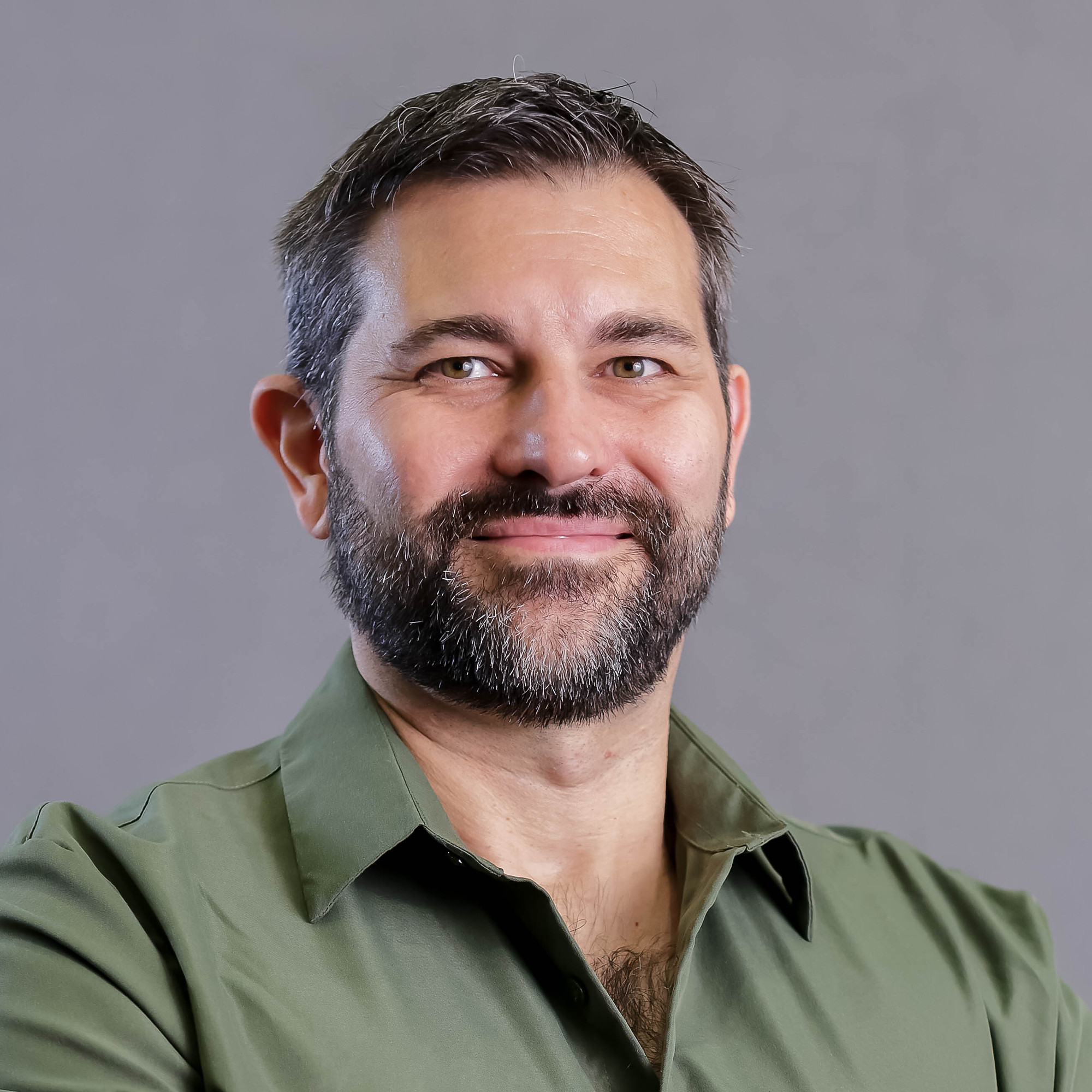
Daniel C. Rodgers, WMCP®, spent twenty years in technology at Microsoft and Google. At Microsoft he was a Product Management Lead for Xbox Live. At Google he was a Senior Manager in Google Cloud's technical program management group, where he led programs delivering AI infrastructure and generative AI services, and served in the technical governance group. He retired at 42 and turned to writing, teaching, and publishing. His first book, Escape The Clock, is an award-winning bestseller on financial independence. His debut novel, Killswitch, won Literary Titan's Gold Book Award for Best Science Fiction. It follows a world that adopted AI so completely it handed over its judgment. He hosts the Escape The Clock podcast and lives outside Seattle.
Website: escapetheclock.com
Books: Killswitch and Escape The Clock
Author / Early Retiree / WMCP®
Daniel C. Rodgers, WMCP®, spent twenty years in technology at Microsoft and Google. At Microsoft he was a Product Management Lead for Xbox Live, and at Google he was a Senior Manager in Google Cloud’s technical program management group, where he led programs delivering AI infrastructure and generative AI services and served in the technical governance group. He retired at 43 and turned to writing, teaching and publishing. His first book, Escape The Clock, is an award-winning bestseller on financial independence. His debut novel, Killswitch, won Literary Titan’s Gold Book Award for Best Science Fiction and follows a world that adopted AI so completely it handed over its judgment. He hosts the Escape The Clock podcast and lives outside Seattle.