
Innovation Portfolio Management: Linking Strategy to Execution

 Apple Podcasts
 Spotify
 Castro
 RSS Feed
 70% of technology transformations fail. Not because of the technology, but because of the gap between a strategy set in the boardroom and the work that actually gets executed.
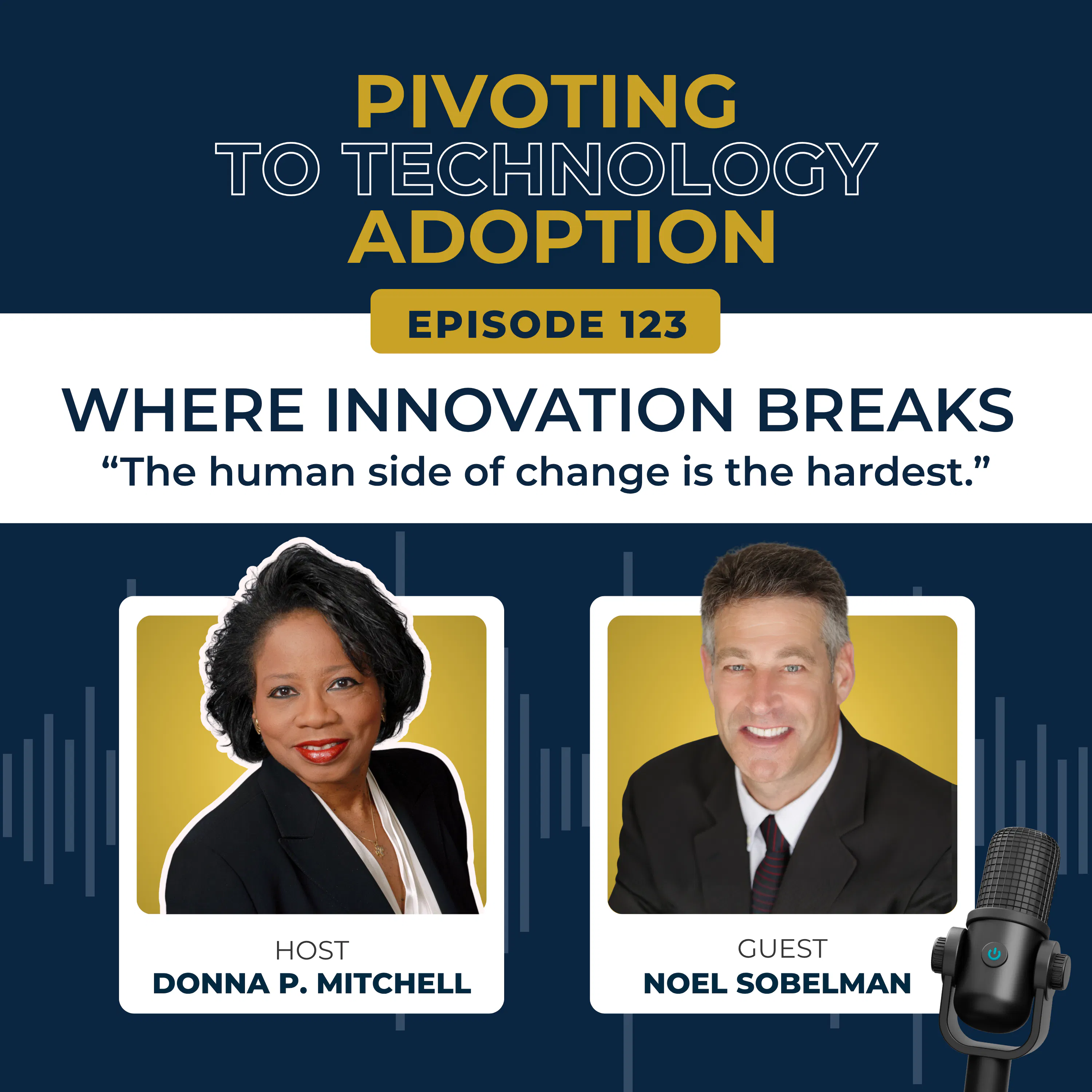
In this episode, Donna P. Mitchell sits down with Noel Sobelman, Partner at Accel Management Group and author of Innovation Portfolio Management: Linking Strategy to Execution. For more than two decades, Noel has helped the world's largest enterprises, including Medtronic, BD, Siemens, Kimberly Clark, Honeywell, and Whirlpool, turn innovation strategy into real execution.
Most leaders think the adoption gap shows up at implementation. Noel sees it forming earlier, in the boardroom, when strategy fragments and the wrong projects get funded. Together they unpack where innovation really breaks: funding the technology before the customer problem, the difference between a project leader and a coordinator, why killing the right project should be rewarded, and the question almost no one can answer, who actually owns adoption.
What you'll learn:
- Why "fall in love with the problem, not the solution" is the discipline most teams skip
- How portfolio management connects strategy to execution
- What separates a true cross-functional leader from a coordinator
- How to reframe a killed project as learning, not failure
- Why the regulatory function, not engineering, is often the real bottleneck in healthcare
- Who should own adoption, and why it is the million dollar question
Noel's book, Innovation Portfolio Management: Linking Strategy to Execution, is available for pre-order now, with the ebook released early to anyone who pre-orders. Connect with Noel on LinkedIn. https://www.linkedin.com/in/noelsobelman/
About the host: Donna P. Mitchell is the founder of The Transformation Authority and CEO of Mitchell Universal Network, LLC. Forbes Business Council Member. Senior Executive Healthcare Think Tank Member. 49 years across five regulated industries, telecommunications, aviation, airline management, healthcare and pharmaceutical, and emerging technologies, enabling 150,000+ professionals through four types of transformation.
Work with Donna: pivotingportal.com Book: amazon.com/author/donnapmitchell Subscribe to The Transformation Brief: transformationbrief.beehiiv.com/subscribe
PIVOTING TO TECHNOLOGY ADOPTION
EP123 — Innovation Portfolio Management: Linking Strategy to Execution
Guest: Noel Sobelman, Partner, Accel Management Group | Author, Innovation Portfolio Management: Linking Strategy to Execution
Host: Donna P. Mitchell, The Transformation Authority
Published: Tuesday, June 30, 2026
FULL EPISODE TRANSCRIPT
Donna P. Mitchell (0:00): Welcome to Pivoting to Technology Adoption. I'm your host, Donna P. Mitchell, the Transformation Authority. Every week, I sit down with executives, strategists, and innovators to tackle the one problem no one's solving. Why 70% of technology transformations fail.
Donna P. Mitchell (0:18): Let's pivot. Good morning. Good afternoon. Good evening. Welcome to pivoting to technology adoption.
Donna P. Mitchell (0:29): And today I've had the pleasure of meeting Noel Sobelman and Noel I'm excited about because he has been around for more than two decades, helping the world's largest enterprises turn innovation strategy into real execution. Companies like Medtronic, BD, Siemens, Kimberly Clark, Honeywell, and Whirlpool. He works where the big companies decide what to fund, what to kill, and how to actually get it done. That's really at the end of the day, he's going get it done. He was a partner managing director at Kalypso and today he heads the Innovation Practice of Accel Management Group.
Donna P. Mitchell (1:05): His forthcoming book is Innovation Linking Strategy to Execution and that's what really attracted me to him because the fact that he's linking the strategy to execution and on the people side of business is what I find where most of the issues and a lot of the impact and what's necessary in today's era to be successful is. What struck me also is where Noel locates the problem. Most people think the adoption gap shows up in implementation. Noel sees it forming earlier in the boardroom when strategy fragments and the wrong projects Get Funded. Noel, welcome to the show.
Donna P. Mitchell (1:45): I'm really excited to have you here with our audience and yours, and just give us a little bit more of your background, what you're doing now, and where do you see all of this going, especially with innovation and implementation and strategy?
Noel Sobelman (2:01): Hi Donna, it's great to be here and I'm looking forward to our conversation. So some more background on me, I've been in the innovation and product development space for most of my career. About half my career has been in industry working in various roles. I've been on project teams, I've led business units. And then the other half of my career, I've been advising companies.
Noel Sobelman (2:25): A lot of the work I do on the advisory side is helping companies build capabilities to innovate. And, a lot of that gets into the strategy realm, and then connecting strategy to, the execution of innovation projects. So that's kind of where I've been focused. I've done work helping companies in their core businesses and then all the way at the other end of the spectrum, creating completely new sources of growth where there's lots of uncertainty, creating new businesses, new business models, which is something corporates are not very good at. The startup world, they try to repeat some of the practices of successful startups and they find it's not so easy in a corporate setting.
Noel Sobelman (3:08): So I've spent a lot, probably the last fifteen years really studying that challenge and helping companies overcome that. We can get into any one of those areas in our conversation.
Donna P. Mitchell (3:18): Well, you just basically said it's not so easy on the corporate setting. How come? What makes it different?
Noel Sobelman (3:23): Well, a lot of leaders that got to where they are, got to where they are by scaling a known business where, you are in, in my world and innovation and product development, you're creating the next generation of a product, maybe a product line extension, or in some cases, you're doing an adjacent product. And they, they built these corporations, they set them up using your typical corporate structure with different functions and various hierarchies and different decision making governance throughout. And, and when you're in that close in mode, that known mode, that's where corporate leaders are comfortable. It's when they get out into the longer term, high risk reward kinds of, of opportunities where there's high uncertainty. And it requires a different form of management instead of asking, you know, where's the ROI upfront?
Noel Sobelman (4:17): As an example, they might, they, they, what they should be asking is, what are the big unknowns or what has to be true for this new, completely new idea to be successful and to scale as a business? So it's about more surfacing the major assumptions in the, in the, the business or the customer need, as opposed to asking for the business case upfront. And that's a big shift for a lot of executives who want that certainty. So that's, that's probably the number one thing I would point to in the innovation space as to why it's so hard. It's just, it's just not what they're used to.
Noel Sobelman (4:54): But they're learning these skills. I think there's a lot of tools out there and there's a lot of, methodology out there to overcome that, but it's taking some time.
Donna P. Mitchell (5:03): You know, you've just helped me. We were talking previously, like what happened? Why is it such a hard job? Why is there so much money being lost? Millions, billions.
Donna P. Mitchell (5:13): And you said something to me, the uncertainty piece where when you look at the technology back in the day, let's say just in the airline industry, we lived in uncertainty. There was a certain comfort level there, whether the agencies got the commission and what are they going to do after, but electronic ticketing, the kiosk, there was a lot of uncertainty and you really had research it or do different things a different way. And the consistency of being in corporate and having a known business with growth and scaling and you're kind of comfortable and you know what you want to do, that's not really what happened a lot of the times, in travel. It was something of uncertainty and it was different, or it was first and it was new and you had to make it happen and not drop the ball. You really helped me with that.
Donna P. Mitchell (6:01): Thank you so much.
Noel Sobelman (6:03): Well, just to build on that comment, I mean, back, I guess in the, in the nineties, who could have predicted, you know, I, you used to go to the, well, know this, that you used to go to the, the travel agent physically and go down there and look at all your options. And then, then the internet happened and it didn't happen overnight, but, and nobody could predict the timing, but if I want to plan a trip, it's on me now. I'm sitting in front of my, it's funny. I went to, I, I went to visit my daughter in Australia and I just go, go into chat GPT and create my whole itinerary, where in the past I would have worked through a travel agent to figure out what I wanted to do down to the hour every day of my trip. Was only there for a week, so it's, it's amazing how quickly that changed and, yeah, preparing for that is, is, it's, it's a tough one.
Donna P. Mitchell (6:53): So on that same thought, on how technology changes society, not even companies, but people and personal. When you look at what's happening today, let's say in the AI space or the technology that's happening now, what are you finding that executives are really missing? What are they missing in, in, in getting the investment or looking at the funding? What should they be thinking about first? Cause from my research, it seems like they're missing the business, the actual business.
Donna P. Mitchell (7:24): Can you give us some insight on that for those that are listening?
Noel Sobelman (7:27): Well, think your intuition is spot on. I would say, there's too much focus on the technology as opposed to first asking the question, are we solving a customer problem? Is there a meaningful, significant problem or a need that's not being met today or a job that needs to, needs to get done at the most fundamental level? Let's really understand that because a lot of these companies I work with, they're very quick to go to the solution or the technology. So there's the making sure there's a problem worth solving.
Noel Sobelman (8:01): And then the other aspect is, making sure that there's a scalable business there. So what needs to be true for the business to scale profitably? That's a different set of questions. So understanding those non technology questions before you even get to the solution, you can learn a lot from your customers and that's part of getting into, more of the agile approach, testing and learning. You can learn a heck of a lot before you build your first prototype, or even your low fidelity prototype.
Noel Sobelman (8:30): So getting out of the building and talking to customers and doing the reverse income statement, figuring out what assumptions will drive a business case for the product, for the opportunity. That's what they're, that's what they're missing. They're too quick to go to the solution, get too excited about the shiny object, the solution, the AI. So it's that phrase fall in love with the problem, not the solution is, is something I find myself repeating more and more. So those, those, those are, that's really where the, I think the gap is.
Donna P. Mitchell (9:01): So when you're speaking to the leadership, who should really be in the room and where do you think they should start? How do they know they're ready to expand or do a project or bring on additional investments? When I've spoken to some CEOs, let's say, the leadership, I guess I should say the leadership overall, a lot of times they don't have data. They don't have everything lined up like they should, but they think they do. How do they know what they should be looking at for infrastructure?
Donna P. Mitchell (9:33): How do they know if they're ready for another innovation? Are there bells and whistles? Are there signals that we can tell them or help them with? Rather you, not me, I don't do that. I'm on the people side.
Donna P. Mitchell (9:46): You help the audience understand for those that are listening where they should really be making some decisions or analysis on whether they're ready to take the next step?
Noel Sobelman (9:57): Well, lot of what I do, Donna, is help companies build the capability to innovate, to do the things we
Donna P. Mitchell (10:04): What's that mean? When you say capability, what's that mean? Infrastructure,
Noel Sobelman (10:07): people, people, what's that process, and tools. So it's, it's, it's, and I, I, I would argue that the people side is the hardest to get right. So, but there's, there's some repeatable process. Sometimes there's tools that enable these practices. So all of that I describe as capability.
Donna P. Mitchell (10:26): Can you give us some examples for those that are listening? I haven't had a lot of people talk like you. Give us an example.
Noel Sobelman (10:31): Yeah. In the book I talk about a discipline called portfolio management. It's the name of the book is innovation portfolio management, linking strategy to execution. So, so helping to set up a, a repeatable, I'll call it a methodology or a process for making decisions at the right place at the right times to where we are making sure that we have the, our, our projects that we're investing in are aligned to our strategy, that we're maximizing the value of the portfolio of, of investments that we're working on, and that we have the right mix of safe short term versus long term. So those are the three main outcomes that we're looking for with this process.
Noel Sobelman (11:13): And guess what? In today's world, like we've been talking about, the pace of change is accelerated. So you can't just do that in your annual, in your annual plan and then execute throughout the year because the world's changing so fast. Our customer behaviors, the dynamics of marketplace and our projects internally are changing all the time. So we need to get, that dynamic capability to always make sure the projects that we're working on, that we're maximizing the value of our projects, that we're, we're saying no to some things because they're low value.
Noel Sobelman (11:44): So our scarce resources could be directed towards our higher value. So implementing the governance structures, where in that corporate hierarchy are decisions made, how are resources allocated, you know, what resources are allocated by who, at what level in the organization, what evaluation criteria are we going to use? Let's agree on, are we going to use an NPV? Are we going to use, more strategic or, or qualitative criteria? Are we going to use both?
Noel Sobelman (12:12): Are we going to use evidence from the customers to make our decisions? So how are we going to make decisions? Is it part of the capability that we help build? And, and, and getting alignment on that is not easy because you got people, and this I'm getting into the people side now, you got people who are used to having all the power in one function, let's say R and D, I'll pick on R and D for a second. The head of R and D used to make the decisions on what we prioritize, what kind of technologies we go after.
Noel Sobelman (12:38): Well, innovation, product development is inherently cross functional. The manufacturing leader, the marketing leader, they all have to, make sure that they're, they're hitting their strategic objectives. So it really is cross functional to get back to your initial question of who was on the governance team, who was making those decisions. It's, it's definitely, at the highest levels of the organization where you have to confront the tension between these silos and organizations. But making decisions, in a review of your portfolio is really a cross functional activity informed by people that are close to the markets, people that are close to the projects.
Noel Sobelman (13:14): So, those are some of the, there's lots of levers in what I'm describing, but those are all, getting all that right is not easy, but there's levels of maturity, you can get started and get better at this capability and build those, those components over time and get better and better about it over time. And then on top of that, of course, you, there's tools out there, so enterprise tools to help enable these processes I'm describing. And then of course, making sure that you're, you're just continuing to build the capabilities to just execute on projects. So I've, I've, I've, described portfolio management, but there's a lot of interdependencies with culture, interdependencies with project execution, strategy. It's portfolio management is that middle layer that connects the strategy to the execution.
Noel Sobelman (14:06): So that's, that's this discipline and that's the capability we're trying to mature.
Donna P. Mitchell (14:10): So when you're doing that, I got a question. In the old days, back in the day, you had one project manager and they did it all. Culture, project, goals, culture, whatever it took, it had to get done. At least in the airline industry, I can speak to that. Recently in the last year, it sounds like they run a project manager and a change management manager, and they're starting to bring them into one and some are using two.
Donna P. Mitchell (14:38): What do you find, what works? I'm kind of curious because with the methodology and having lived experience as a practitioner and an operator, you see things for what they are, or you can kind of see it quicker, I guess, because of the experience, the patterns, the recognition, living with the culture, having to make a decision with the culture to get the project moving and get over the project going on. This is the culture you're in and they're not going to change. You got to make it work. So at the end of the day, what do you find working today?
Donna P. Mitchell (15:08): What are they actually using as you go through the innovation infrastructure and the enablement? How is that working today? I'm really curious about that because there seems to be two schools of thought and all this new methodology that they teach.
Noel Sobelman (15:21): Well, at the project level, or you can call it an initiative, it doesn't have to be a product or an innovation. It can be a, an internal initiative. I like the idea of a single point accountable person who is a leader driving a cross functional team. First of all, you have to have that cross functional team. We call it a coach And that maps to the broader set of stakeholders that are, that are, individual contributors for a project organization.
Donna P. Mitchell (15:45): For us, it was global. It was, you had to have everybody, internal, external customers, cruise lines, everybody. You had everybody.
Noel Sobelman (15:51): And what I tell, what I tell leaders is I don't care what function they come from. What I want is a true leader. I want somebody that when the CEO wants to know what's going on on the project or hears something in the hallways, is something wrong? Who are they going to pick up the phone and call? Today, that person is the VP of R and D or the VP of marketing.
Noel Sobelman (16:11): They're not calling the project leader. So getting that project leader who has the internal clout to get things done. The function that understands the business, understands the customer to some extent, that's the person, the ideal person, I should say, that we want leading the initiative or the project. Not easy to find that type of person, but that should be the, the, the goal, the ambition to have true leadership. We call them, used to call them a mini general manager or mini CEO because it is a cross functional role. And a lot of projects, at least in my world, teams get, the person in that spot is usually the most senior technical person or an op- it's often the person that is, is out of, let's say R and D that understands the technology, which is helpful, but if they don't have that business mindset, because the goal of the project, the goal of the initiative of the project is, is success in the market or success when you, when you implement it. So it's not just about the technology.
Noel Sobelman (17:08): It's not, and I'm tend to, I'm picking on R and D now, but it really is somebody that can break down silos and drive a cross functional initiative team to, to, and hold them jointly accountable for the success in the market as opposed to making sure they meet their functional objectives.
Donna P. Mitchell (17:25): Okay. So you helped me with something else. So what I see from based on what you said, industry level, that they need to be industry level to be able to be cross functional and have impacts on no matter what room and size of the room and who's there, they can read the scene and make it happen and bring in the right players or find the person in the room. It could be the quietest person there that has the power and influence, but you have to have someone who's beyond, like you said, the most technical person or the one who's on that team, someone who really has the business division and who has the skill level to really recognize what needs to be done for the good of the project, the company, and the people.
Noel Sobelman (18:05): Yeah. Drawing out that quiet person. That's a, that's a, a behavioral skill and, if what it's not is a coordinator, because too often it is. The person that's managing the schedule, that's assigning action items and running around following that in large organizations, sometimes it's helpful to have, we call it two in the box, the leader and the coordinator. But this, again, the emphasis is more on, on cross functional leadership than the tactical, and, and too often it's not.
Noel Sobelman (18:41): And I'm making it sound like it's easy to find these people, but that should, again, that should be, what we, what, what, one thing that we've done a lot of is, is a skills assessment. And we get the question all the time, who are, let's find our best leaders. And we have, you know, a set of characteristics that we look for that go beyond the tactical or the technical. They get into some of these human behaviors and we try to identify who are, who are the most qualified, but more importantly, where are the gaps so we can build a training plan and get people to that level where they can be trusted and they, they are decision makers as opposed to having to go through layers of, of the hierarchy to make, to get permission to make decisions. So, identifying those people, identifying the skillset gaps for those leaders and building those skills is really, really, an important, important part of the career development plan.
Donna P. Mitchell (19:35): The reason I'm asking, and then we're going to talk about some other things besides what my questions are since you're here, is because back then, and I'm not sure about now, but I can only speak about back then in this instance, is because you had unions and you had so many departments and the airline industry was just so big. You had to pay attention to everything, you know, not just the finance and the legal and the compliance and the adherence, but you also had to look at the product and the customer and the internal customer and the industry rules. And it was just so much at once at a high level. And coming back into the technology adoption piece now and the meetings that I am having and the awareness and the learning and the education, I'm finding that some things have really changed and some things have just been missed or they didn't learn it yet. Something just happened through the time period.
Donna P. Mitchell (20:31): So I really appreciate the insight. When you look at a company and you have the decision makers there and they have to kill a project or they have to change something, how do they go about doing that? How does that really feel when they really have to chop or lose a lot of people or readjust the strategy and the strategy and the money is not in alignment, or the strategy and the vision and the goals change, how is that managed or handled?
Noel Sobelman (20:58): Well, saying no or killing a project that people are emotionally invested in is challenging. But the worst thing you could do is continue to spend money on something that is not the good, the right fit for the strategy or is not, is clearly not going to win in the marketplace. So the idea is how do we find out that it's not going to work as early as possible so we don't waste a lot of time and money? And then when you do say no to a project, the team, you know, the team is celebrated for making the right recommendation. As opposed to, too often a team will come back to the investment decision makers and, and, you know, show them the hockey stick curves and, projections and, try to keep their project alive because they, you know, cause they're, you know, they're humans, they're emotionally attached to it.
Noel Sobelman (21:47): And there's a lot of pride in what they've, what they've gotten to. So there's that sunk cost or emotional sunk cost. But the decision makers have to make decisions about the go forward. Going forward, is this the right opportunity given the other things we can invest in? So, the best, the best way to do that is to reframe and don't, it's not about failure.
Noel Sobelman (22:08): It's about what, you know, what did we learn? So reframing that failure as learning, what did we learn from this? And then telling the team, you saved us a ton of money because we were about to spend an extra, you know, several millions of dollars to get this thing all the way to market. But you learn that there's, there's, the customers don't really, they won't pay for the solution that we've been working on. Maybe we need to pivot, maybe we don't kill it.
Noel Sobelman (22:32): Maybe we need to pivot and go in a different direction. Same North Star, same end goal strategy, but we needed to get there in a different way and that should be rewarded as well. So, but you do need to say no in order to some, low value projects in order to make sure that the higher value projects are accelerated, are delivered on time and, and it's a predictable, system for delivering products And, and, and just taking away the, the stigma associated with, my project got killed, so I failed. That's not, that's not the message. So changing that message is important.
Donna P. Mitchell (23:05): So when you, when you have resistance and it's from different levels and everything at that point, what is usually happening with leadership when there's resistance in the organization and it's, and it's not really in sync at all? What do you usually find? What are the trends?
Noel Sobelman (23:24): Yeah. And hopefully you can spot some of that resistance early on. And let's just call it, I do a lot of these more transformational change initiatives about implementing a new way of working, a new capability. And one of the first things we like to do is do some benchmarking. How do we, how are we performing relative to our peers in the industry along a number of dimensions for product development?
Noel Sobelman (23:47): It's things like return on R and D investment or schedule predictability, time to market, those kinds of metrics. If you can compare those to your competitors or even outside your industry, in some cases, you can come back with a fact base and get alignment around where the gaps are. Where, where are we today versus where we want to be? And if, and if we're lagging our peers in the industry, it helps upfront to make sure that, leadership are all aligned, that yes, we have some challenges. Here's the priorities of what we're going to improve, what we're going to take on.
Noel Sobelman (24:20): So that upfront alignment, clearly articulating the why we're changing is important to help deal with resistance to change. And then making sure that management's committed, not just by having the town hall and cheerleading for the project, but really in all the day to day actions that leadership takes, your employees are watching that. There's, you're always sending signals. I was working with a client recently where the CEO came down to our, in the basement of the building where the working team was working on a new way, a new architecture for setting up a portfolio management system. And he came down and just sat, sat in on a meeting for two hours.
Noel Sobelman (24:57): And at the end of the meeting, went around and just, just got to know the team. And that just went a long way towards, you know, this person's willing to take two hours out of, out of her busy schedule and spend it with the team. And, the, the employees recognize that. So those signals that you're sending as a leader are critical. Otherwise they're gonna view this, this initiative as, oh, I'll just wait for it to kind of fade like the other ones did.
Noel Sobelman (25:23): So this, this, this, the signals, and then of course the reward systems are important as well. Making sure that, people understand the what's in it for me. They have an answer to that question. If you know, why should I change? I'm comfortable in this current state, this future state we're working towards.
Noel Sobelman (25:41): I want to know what what's in it for me and why my life's going get better, that sort of thing. So making sure you highlight that. And then the last thing I'll say is really involving the stakeholders in the change. People are going to adopt the change that they had a hand in, you know, they want to adopt a future state that they had a So hand in if you involve them every step of the way from that, that initial benchmarking assessment that we talked about, all the way through re architecting the way we work and the day to day processes. If they're involved in that, they're more likely to adopt it.
Noel Sobelman (26:12): So getting, getting that involvement is going to be critical. And then, and then continuing to, to, check-in with them. They're the, they're going to have ideas that leaders didn't think of. So involving them, as a more of a co development effort of the new way of working is important.
Donna P. Mitchell (26:26): Thank you. So you have been involved with Medtronic. Medtronic, BD, Siemens, but you've been in the healthcare space. What are some of the observations and patterns that you see there that really needs to be looked at and some of the trends can be rectified to maybe move in a more successful direction, even with compliance. Healthcare seems to be in a place and space where people are human and you even have physicians that are in fear of technology.
Donna P. Mitchell (27:07): Even though their social status, economic status, and who they are is utmost important, you still find some of the same resistance and fear. So what can you share to those listening who are in the healthcare space in this time of advancement in so many tools and so many different capacities changing and functionalities changing and diagnostics changing. Can you share some insight on that?
Noel Sobelman (27:35): Yeah. And, and the first thing I'll say is the principles that we've been talking about don't really change from industry, that much from industry to industry. And I've worked in everything from semiconductors to haircare, to medical devices. And I do do a lot of work, work, support a lot of clients in the life sciences. And the one thing that I'd say that's unique to that is, you know, there, there are regulatory hurdles and there's, there's, there's, the guidelines are changing.
Noel Sobelman (28:00): And, one of the things I see over and over again is I do a lot of work helping companies to figure out the resource allocation challenge to make sure the right people are working on the projects and you're, you're not exceeding capacity and your throughput is, of your new projects are on time. One of the things that I always highlight is that your bottleneck is not going to always be the engineering or the R and D, it might be regulatory. Typically in most large companies, rego- the regulatory affairs person is on multiple teams, they're spread very thin. And if that's the bottleneck, then the whole project suffers. The whole pipeline is going to get slowed down.
Noel Sobelman (28:39): So making sure you're not just looking at your supply and demand for engineers or, or, or, some of the more obvious, functions, but that compliance or that regulatory function, which is critical, that you're, you're making sure you have the visibility, especially when it comes, you know, downstream when they're, when they're preparing for a submission. But even way before that, when you're thinking about your regulatory pathway, making sure you're thinking about the, the resources required from the regulatory function, and, and then having the visibility as to where the constraints are so you can be proactive about doing something about that constraint. Maybe, maybe you get some help outside, maybe you stagger your project so they don't all hit that same bottleneck at the same time, because, that'll slow, like I say, that'll slow down the overall project. So, paying close attention to resource allocation, in those, some people call them more support functions, but they're just as important when it comes to delivering the value to customer.
Donna P. Mitchell (29:40): So before we close, I definitely want to know, when's your book coming out?
Noel Sobelman (29:45): It'll be, it's available for pre order now. It'll be out in September and, I'm going to be, offering the ebook version for anybody that pre orders it so they can get the ebook right away and not have to wait So until right around the corner, but, I'm trying to, trying to make sure to get it out there, even before September. So, for those that are interested, they can, they can, contact me directly on LinkedIn and, and, if they're willing to, to, to pre order it, I'll make sure they get an e book so they can start reading it.
Donna P. Mitchell (30:17): And what are the key takeaways you like anyone that was listening today to really understand?
Noel Sobelman (30:22): Yeah, Donna, we touched on a lot, but, I think the fact that the human side of change is the hardest because you can, you can do all the things we talked about. You can then set up your governance, you can create evaluation criteria, you can improve your, your pipeline throughput and resolve resource bottlenecks. But if these methodologies don't get adopted and used, you're not going to see the benefits. So, really paying close attention to the, the resistors like you brought up and making sure that you turn them into advocates for a new way of working and really pay attention to the organizational change side of any initiative is critical. I've done a lot of process improvement work, a lot of systems implementations, but it's the people side that is the toughest.
Noel Sobelman (31:12): People are just, you know, they they're, they're set in their ways. So you, you need to really be thinking about that throughout any engagement.
Donna P. Mitchell (31:18): And lastly, is there any one officer that really should be in control or let's say own the adoption? Who owns the adoption? A lot of people say the CEO, but then some people are starting to say the CEO really doesn't own the adoption piece. Who really owns the adoption piece? Is anybody owning the adoption piece to make sure it gets done?
Donna P. Mitchell (31:38): That's the million dollar question.
Noel Sobelman (31:41): Yeah. You know, we, we set up steering committees and get leadership engaged and all of that. But you know, like I said earlier, innovation, product development, the areas I focus on, it really is cross functional. But when, when we talked at the beginning about the difference between high uncertainty and known execution of projects, there's going to be tension. And that has to be confronted.
Noel Sobelman (32:04): That tension has to be confronted all the way up to the CEO because, you're going to have competing objectives. There's going to be corporate politics and, and the, the, today's business is going to win out every time, every time we have to, we have to hit our quarterly numbers. So you're going to, if you continue to ignore the future and that, that new source of growth we talked about, you're going be in trouble. You're going to be vulnerable to disruption. That tension between core and exploratory new products or new, new, new business models has to be confronted at the highest levels.
Donna P. Mitchell (32:34): How can folks reach you? LinkedIn?
Noel Sobelman (32:36): LinkedIn is probably the best, place to just shoot me a message over LinkedIn and let's get connected and happy to continue the conversation with anybody and, and love talking about this stuff and hopefully once the book's out, more people will, you know, the book is really a how to, how to set up the capabilities that we talked about. So I'm hoping that, more and more companies can adopt the methodology that, I've been working with for decades now.
Donna P. Mitchell (33:03): I've enjoyed talking to you and I'm really looking forward to the book. So I'd like to thank you for being on Pivoting to Technology Adoption. And this is Noel Sobelman and Donna Mitchell, and thank you for listening. We're Shaping Tomorrow Together.
Noel Sobelman (33:16): Thank you, Donna.
Donna P. Mitchell (33:17): Thank you for listening to Pivoting to Technology Adoption. If this episode gave you something to think about, subscribe, leave a review, and share it with a colleague who needs to hear it. My new book, Pivoting to Technology Adoption: Mind the Gap, is available now on Amazon. Visit pivotingportal.com to work with me directly. I'm Donna P. Mitchell, the transformation authority until next time.
Donna P. Mitchell (33:43): Mind the gap.

Noel Sobelman works with corporate leaders to accelerate core business vitality while simultaneously building new sources of growth. For the past 25 years, he has worked in the areas of growth strategy, innovation capability building, portfolio management, organization design, ecosystem development, and digital enablement. He is widely recognized for bringing a practical and applicable approach to companies looking to ignite change. Prior to joining Accel Management Group, Noel was a Partner & Managing Director with Kalypso. His background also includes senior-level corporate roles, new venture creation, and executive advisory.